

| 000 | 00000cam u2200205 a 4500 | |
| 001 | 000000655148 | |
| 005 | 20240425170038 | |
| 008 | 990610s2000 njua b 001 0 eng | |
| 010 | ▼a 99026609 | |
| 020 | ▼a 0130224448 | |
| 040 | ▼a DLC ▼c DLC ▼d C#P ▼d 211009 | |
| 049 | ▼l 111143550 | |
| 050 | 0 0 | ▼a HG6024.A3 ▼b H85 2000 |
| 082 | 0 4 | ▼a 332.64/5 ▼2 22 |
| 084 | ▼a 332.645 ▼2 DDCK | |
| 090 | ▼a 332.645 ▼b H913o4 | |
| 100 | 1 | ▼a Hull, John C., ▼d 1946- ▼0 AUTH(211009)48617. |
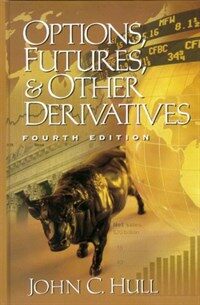
| 245 | 1 0 | ▼a Options, futures, other derivatives / ▼c John C. Hull. |
| 246 | 3 | ▼a Options, futures, and other derivatives |
| 250 | ▼a 4th ed. | |
| 260 | ▼a Upper Saddle River, NJ : ▼b Prentice Hall, ▼c c2000. | |
| 300 | ▼a xix, 698 p. : ▼b ill. ; ▼c 24 cm.+ ▼e 1 computer disk (3 1/2 in.). | |
| 500 | ▼a Disk contains Excel-based software, DerivaGem. | |
| 504 | ▼a Includes bibliographical references and indexes. | |
| 650 | 0 | ▼a Futures. |
| 650 | 0 | ▼a Stock options. |
| 650 | 0 | ▼a Derivative securities. |
소장정보
| No. | 소장처 | 청구기호 | 등록번호 | 도서상태 | 반납예정일 | 예약 | 서비스 |
|---|---|---|---|---|---|---|---|
| No. 1 | 소장처 중앙도서관/서고6층/ | 청구기호 332.645 H913o4 | 등록번호 111143550 (42회 대출) | 도서상태 대출가능 | 반납예정일 | 예약 | 서비스 |
컨텐츠정보
책소개
For undergraduate and graduate courses in Options and Futures, Financial Engineering and Risk Management, typically found in business, finance, economics and mathematics departments. Also suitable for practitioners who want to acquire a working knowledge of how derivatives can be analyzed.This best seller represents how academia and real-world practice have come together with a common respect and focus of theory and practice. It provides a unifying approach to the valuation of all derivatives--not just futures and options. It assumes that the reader has taken an introductory course in finance and an introductory course in probability and statistics. No prior knowledge of options, futures contracts, swaps, and so on is assumed.
정보제공 :

저자소개
존 헐(지은이)
토론토 대학 조셉 엘 로트만 경영대학원의 대학교수다. 이 책을 쓰기 전에 파생상품과 위험관리 분야에서 베스트셀러 3권을 썼다. 그의 책 모두 실무 적용에 초점을 두고 있으며, 저자는 저서가 실무자와 대학 시장에서 동등하게 잘 팔린다는 것을 자랑스럽게 생각한다. 그리고 그는 금융 혁신의 모든 측면에서 연구와 교육 자료를 개발하는 로트맨의 금융 혁신 연구소 핀허브의 학술 이사다. 전 세계의 많은 기업을 위해 자문해 왔고 토론토 대학의 권위 있는 노스럽 프리에 상을 포함한 많은 교수 상을 받았다.
목차
CONTENTS
Preface = xvii
CHAPTER 1. Introduction = 1
  1.1 Forward Contracts = 1
  1.2 Futures Contracts = 4
  1.3 Options = 5
  1.4 Other Derivatives = 10
  1.5 Types of Traders = 11
  1.6 Those Big Losses = 14
  Summary = 15
  Questions and Problems = 16
  Assignment Questions = 18
CHAPTER 2. Futures Markets and the Use of Futures for Hedging = 19
  2.1 Trading Futures Contracts = 19
  2.2 Specification of the Futures Contract = 20
  2.3 Operation of Margins = 23
  2.4 Newspaper Quotes = 27
  2.5 Convergence of Futures Price to Spot Price = 32
  2.6 Settlement = 33
  2.7 Regulation = 34
  2.8 Hedging Using Futures = 35
  2.9 Optimal Hedge Ratio = 39
  2.10 Rolling the Hedge Forward = 40
  2.11 Accounting and Tax = 42
  Summary = 44
  Suggestions for Further Reading = 45
  Questions and Problems = 46
  Assignment Questions = 48
CHAPTER 3. Forward and Futures Prices = 50
  3.1 Some Preliminaries = 51
  3.2 The Forward Price for an Investment Asset = 55
  3.3 The Effect of Known Income = 57
  3.4 The Effect of a Known Dividend Yield = 58
  3.5 Value of a Forward Contract = 59
  3.6 Forward Prices versus Futures Prices = 60
  3.7 Stock Index Futures = 62
  3.8 Foreign Currencies = 68
  3.9 Futures on Commodities = 70
  3.10 The Cost of Carry = 73
  3.11 Delivery Options = 73
  3.12 Futures Prices and the Expected Future Spot Price = 74
  Summary = 76
  Suggestions for Further Reading = 77
  Questions and Problems = 79
  Assignment Questions = 81
  Appendix 3A : Assets Providing Dividend Yields = 83
  Appendix 3B : Proof That Forward and Futures Prices Are Equal When Interest Rates Are Constant = 85
CHAPTER 4. Interest Rates and Duration = 87
  4.1 Types of Rates = 87
  4.2 Zero Rates = 88
  4.3 Bond Pricing = 88
  4.4 Determining Zero Rates = 90
  4.5 Forward Rates = 93
  4.6 Forward-Rate Agreements = 95
  4.7 Theories of the Term Structure = 97
  4.8 Day Count Conventions = 98
  4.9 Quotations = 99
  4.10 Interest Rate Futures = 101
  4.11 Treasury Bond Futures = 103
  4.12 Eurodollar Futures = 107
  4.13 Duration = 108
  4.14 Duration-Based Hedging Strategies = 111
  4.15 Limitations of Duration = 112
  Summary = 114
  Suggestions for Further Reading = 115
  Questions and Problems = 116
  Assignment Questions = 119
CHAPTER 5. Swaps = 121
  5.1 Mechanics of Interest Rate Swaps = 121
  5.2 The Comparative Advantage Argument = 128
  5.3 Valuation of Interest Rate Swaps = 131
  5.4 Currency Swaps = 135
  5.5 Valuation of Currency Swaps = 139
  5.6 Other Swaps = 141
  5.7 Credit Risk = 143
  Summary = 144
  Suggestions for Further Reading = 145
  Questions and Problems = 146
  Assignment Questions = 148
  Appendix 5A : Construction of Zero-Coupon LIBOR Curve = 150
CHAPTER 6. Options Markets = 151
  6.1 Underlying Assets = 151
  6.2 Specification of Stock Options = 152
  6.3 Newspaper Quotes = 156
  6.4 Trading = 158
  6.5 Commissions = 159
  6.6 Margins = 160
  6.7 The Options Clearing Corporation = 162
  6.8 Regulation = 163
  6.9 Taxation = 163
  6.10 Warrants, Executive Stock Options, and Convertibles = 165
  Summary = 166
  Suggestions for Further Reading = 166
  Questions and Problems = 167
  Assignment Questions = 167
CHAPTER 7. Properties of Stock Option Prices = 168
  7.1 Factors Affecting Option Prices = 168
  7.2 Assumptions and Notation = 170
  7.3 Upper and Lower Bounds for Option Prices = 171
  7.4 Put-Call Parity = 174
  7.5 Early Exercise : Calls on a Non-Dividend-Paying Stock = 175
  7.6 Early Exercise : Puts on a Non-Dividend-Paying Stock = 176
  7.7 Relationship Between American Put and Call Prices = 178
  7.8 The Effect of Dividends = 179
  7.9 Empirical Research = 180
  Summary = 181
  Suggestions for Further Reading = 182
  Questions and Problems = 183
  Assignment Questions = 184
CHAPTER 8. Trading Strategies Involving Options = 185
  8.1 Strategies Involving a Single Option and a Stock = 185
  8.2 Spreads = 187
  8.3 Combinations = 194
  8.4 Other Payoffs = 197
  Summary = 197
  Suggestions for Further Reading = 198
  Questions and Problems = 198
  Assignment Questions = 199
CHAPTER 9. Introduction to Binomial Trees = 201
  9.1 A One-Step Binomial Model = 201
  9.2 Risk-Neutral Valuation = 205
  9.3 Two-Step Binomial Trees = 206
  9.4 A Put Option Example = 209
  9.5 American Options = 210
  9.6 Delta = 211
  9.7 Matching Volatility with u and d = 213
  9.8 Binomial Trees in Practice = 214
  Summary = 215
  Suggestions for Further Reading = 216
  Questions and Problems = 216
  Assignment Questions = 217
CHAPTER 10. Model of the Behavior of Stock Prices = 218
  10.1 The Markov Property = 218
  10.2 Continuous Time Stochastic Processes = 219
  10.3 The Process for Stock Prices = 225
  10.4 Review of the Model = 226
  10.5 The Parameters = 228
  10.6 Ito's Lemma = 229
  Summary = 231
  Suggestions for Further Reading = 232
  Questions and Problems = 232
  Assignment Questions = 234
  Appendix 10A : Derivation of Ito's Lemma = 235
CHAPTER 11. The Black-Scholes Model = 237
  11.1 Lognormal Property of Stock Prices = 237
  11.2 The Distribution of the Rate of Return = 239
  11.3 Volatility = 241
  11.4 Concepts Underlying the Black-Scholes-Merton Differential Equation = 244
  11.5 Derivation of the Black-Scholes-Merton Differential Equation = 246
  11.6 Risk-Neutral Valuation = 248
  11.7 Black-Scholes Pricing Formulas = 250
  11.8 Cumulative Normal Distribution Function = 252
  11.9 Warrants Issued by a Company on Its Own Stock = 253
  11.10 Implied Volatilities = 255
  11.11 The Causes of Volatility = 255
  11.12 Dividends = 257
  Summary = 262
  Suggestions for Further Reading = 263
  Questions and Problems = 264
  Assignment Questions = 266
  Appendix 11A : Proof of Black-Scholes-Merton Formula = 268
  Appendix 11B : Exact Procedure for Calculating Values of American Calls on Dividend-Paying Stocks = 271
  Appendix 11C : Calculation of Cumulative Probability in Bivariate Normal Distribution = 272
CHAPTER 12. Options on Stock Indices, Currencies, and Futures = 273
  12.1 Results for a Stock Paying a Continuous Dividend Yield = 273
  12.2 Option Pricing Formulas = 275
  12.3 Options on Stock Indices = 277
  12.4 Currency Options = 282
  12.5 Futures Options = 285
  12.6 Valuation of Futures Options Using Binomial Trees = 291
  12.7 A Futures Price as a Stock Paying a Continuous Dividend Yield = 293
  12.8 Black's Model for Valuing Futures Options = 294
  12.9 Comparison of Futures Option and Spot Option Prices = 295
  Summary = 296
  Suggestions for Further Reading = 297
  Questions and Problems = 298
  Assignment Questions = 302
  Appendix 12A : Derivation of Differential Equation Satisfied by a Derivative Dependent on a Stock Providing a Continuous Dividend Yield = 303
  Appendix 12B : Derivation of Differential Equation Satisfied by a Derivative Dependent on a Futures Price = 305
CHAPTER 13. The Greek Letters = 307
  13.1 Example = 307
  13.2 Naked and Covered Positions = 308
  13.3 A Stop-Loss Strategy = 308
  13.4 Delta Hedging = 310
  13.5 Theta = 319
  13.6 Gamma = 322
  13.7 Relationship among Delta, Theta, and Gamma = 326
  13.8 Vega = 326
  13.9 Rho = 329
  13.10 Hedging in Practice = 329
  13.11 Scenario Analysis = 330
  13.12 Portfolio Insurance = 331
  13.13 Stock Market Volatility = 334
  Summary = 335
  Suggestions for Further Reading = 336
  Questions and Problems = 337
  Assignment Questions = 339
  Appendix 13A : Taylor Series Expansions and Hedge Parameters = 341
CHAPTER 14. Value at Risk = 342
  14.1 Daily Volatilities = 342
  14.2 Calculation of VaR in Simple Situations = 343
  14.3 A Linear Model = 345
  14.4 How Interest Rates Are Handled = 346
  14.5 When the Linear Model Can Be Used = 350
  14.6 A Quadratic Model = 352
  14.7 Monte Carlo Simulation = 355
  14.8 Historical Simulation = 356
  14.9 Stress Testing and Back-Testing = 357
  14.10 Principal Components Analysis = 357
  Summary = 361
  Suggestions for Further Reading = 362
  Questions and Problems = 362
  Assignment Questions = 364
  Appendix 14A : Use of the Cornish-Fisher Expansion to Estimate VaR = 366
CHAPTER 15. Estimating Volatilities and Correlations = 368
  15.1 Estimating Volatility = 368
  15.2 The Exponentially Weighted Moving Average Model = 370
  15.3 The GARCH(1, 1) Model = 372
  15.4 Choosing Between the Models = 374
  15.5 Maximum Likelihood Methods = 374
  15.6 Using GARCH(1, 1) to Forecast Future Volatility = 379
  15.7 Correlations = 382
  Summary = 384
  Suggestions for Further Reading = 385
  Questions and Problems = 386
  Assignment Questions = 387
CHAPTER 16. Numerical Procedures = 388
  16.1 Binomial Trees = 388
  16.2 Using the Binomial Tree for Options on Indices, Currencies, and Futures Contracts = 395
  16.3 Binomial Model for a Dividend-Paying Stock = 398
  16.4 Extensions of the Basic Tree Approach = 401
  16.5 Alternative Procedures for Constructing Trees = 403
  16.6 Monte Carlo Simulation = 406
  16.7 Variance Reduction Procedures = 411
  16.8 Finite Difference Methods = 415
  16.9 Analytic Approximation to American Option Prices = 425
  Summary = 425
  Suggestions for Further Reading = 426
  Questions and Problems = 428
  Assignment Questions = 431
  Appendix 16A : Analytic Approximation to American Option Prices = 432
CHAPTER 17. Volatility Smiles and Alternatives to Black-Scholes = 435
  17.1 Preliminaries = 435
  17.2 Foreign Currency Options = 436
  17.3 Equity Options = 438
  17.4 The Volatility Term Structure = 440
  17.5 Volatility Matrices = 441
  17.6 Relaxing the Assumptions in Black-Scholes = 442
  17.7 Alternative Models for Stock Options = 443
  17.8 Pricing Models Involving Jumps = 445
  17.9 Stochastic Volatility Models = 446
  17.10 Empirical Research = 448
  Summary = 450
  Suggestions for Further Reading = 450
  Questions and Problems = 453
  Assignment Questions = 454
  Appendix 17A : Pricing Formulas for Alternative Models = 455
CHAPTER 18. Exotic Options = 458
  18.1 Types of Exotic Options = 458
  18.2 Path-Dependent Derivatives = 471
  18.3 Lookback Options = 475
  18.4 Barrier Options = 477
  18.5 Options on Two Correlated Assets = 482
  18.6 Implied Trees = 485
  18.7 Hedging Issues = 487
  18.8 Static Options Replication = 487
  Summary = 489
  Suggestions for Further Reading = 491
  Questions and Problems = 492
  Assignment Questions = 494
  Appendix 18A : Calculation of the First Two Moments of Arithmetic Averages and Baskets = 496
CHAPTER 19. Extensions of the Theoretical Framework for Pricing Derivatives : Martingales and Measures = 498
  19.1 The Market Price of Risk = 498
  19.2 Derivatives Dependent on Several State Variables = 503
  19.3 Derivatives Dependent on Commodity Prices = 506
  19.4 Martingales and Measures = 507
  19.5 Alternative Choices for the Numeraire = 510
  19.6 Extension to Multiple Independent Factors = 513
  19.7 Applications = 514
  19.8 Change of Numeraire = 517
  19.9 Quantos = 518
  19.10 Siegel's Paradox = 521
  Summary = 521
  Suggestions for Further Reading = 522
  Questions and Problems = 523
  Assignment Questions = 525
  Appendix 19A : Generalization of Ito's Lemma = 526
  Appendix 19B : Derivation of the General Differential Equation Satisfied by Derivatives = 527
CHAPTER 20. Interest Rate Derivatives : The Standard Market Models = 530
  20.1 Black's Model = 531
  20.2 Bond Options = 533
  20.3 Interest Rate Caps = 537
  20.4 European Swap Options = 543
  20.5 Generalizations = 547
  20.6 Convexity Adjustments = 547
  20.7 Timing Adjustments = 552
  20.8 When Is an Adjustment Necessary? = 555
  20.9 Accrual Swaps = 556
  20.10 Spread Options = 557
  20.11 Hedging Interest Rate Derivatives = 557
  Summary = 558
  Suggestions for Further Reading = 559
  Questions and Problems = 559
  Assignment Questions = 561
  Appendix 20A : Proof of the Convexity Adjustment Formula = 563
CHAPTER 21. Interest Rate Derivatives : Models of the Short Rate = 564
  21.1 Equilibrium Models = 564
  21.2 One-Factor Equilibrium Models = 565
  21.3 The Rendleman and Bartter Model = 566
  21.4 The Vasicek Model = 567
  21.5 The Cox, Ingersoll, and Ross Model = 570
  21.6 Two-Factor Equilibrium Models = = 571
  21.7 No-Arbitrage Models = 571
  21.8 The Ho and Lee Model = 572
  21.9 The Hull and White Model = 574
  21.10 Options on Coupon-Bearing Bonds = 577
  21.11 Interest Rate Trees = 578
  21.12 A General Tree-Building Procedure = 580
  21.13 Nonstationary Models = 591
  21.14 Calibration = 593
  21.15 Hedging Using a One-Factor Model = 594
  21.16 Forward Rates and Futures Rates = 595
  Summary = 596
  Suggestions for Further Reading = 596
  Questions and Problems = 598
  Assignment Questions = 599
CHAPTER 22. Interest Rate Derivatives : More Advanced Models = 601
  22.1 Two-Factor Models of the Short Rate = 601
  22.2 The Heath, Jarrow, and Morton Approach = 604
  22.3 The LIBOR Market Model = 609
  22.4 Mortgage-Backed Securities = 615
  Summary = 618
  Suggestions for Further Reading = 618
  Questions and Problems = 620
  Assignment Questions = 620
  Appendix 22A : The A(t, T), σp , and θ (t) Functions in the Two-Factor Hull-White Model = 621
CHAPTER 23. Credit Risk = 623
  23.1 The Probability of Default and Expected Losses = 624
  23.2 Adjusting the Prices of Derivatives to Reflect Counterparty Default Risk = 632
  23.3 Credit Value at Risk = 641
  23.4 Credit Derivatives = 644
  23.5 Valuation of Convertible Bonds = 646
  Summary = 648
  Suggestions for Further Reading = 649
  Questions and Problems = 650
  Assignment Questions = 652
  Appendix 23A : Manipulation of the Matrices of Credit Rating Changes = 654
Glossary of Notation = 655
Glossary of Terms = 658
DerivaGem Software = 672
Major Exchanges Trading Futures and Options = 676
Table for N(x) when x ≤ 0 = 678
Table for N(x) when x ≥ 0 = 679
Author Index = 680
Subject Index = 683