

| 000 | 00000cam u2200205 a 4500 | |
| 001 | 000045954713 | |
| 005 | 20180913110408 | |
| 008 | 180912s2017 enka b 001 0 eng d | |
| 010 | ▼a 2017448094 | |
| 020 | ▼a 1787144720 | |
| 020 | ▼a 9781787144729 | |
| 035 | ▼a (KERIS)REF000018558160 | |
| 040 | ▼a YDX ▼b eng ▼c YDX ▼e rda ▼d BTCTA ▼d KSG ▼d CPE ▼d OCLCF ▼d DLC ▼d 211009 | |
| 043 | ▼a a-ko--- | |
| 050 | 0 0 | ▼a JQ1725 ▼b .E96 2017 |
| 082 | 0 4 | ▼a 320.95195 ▼2 23 |
| 084 | ▼a 320.953 ▼2 DDCK | |
| 090 | ▼a 320.953 ▼b E96 | |
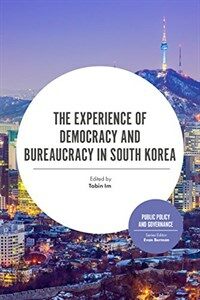
| 245 | 0 4 | ▼a The experience of democracy and bureaucracy in South Korea / ▼c edited by Tobin Im, Graduate School of Public Administration, Seoul National University, South Korea. |
| 250 | ▼a First edition. | |
| 260 | ▼a Bingley, UK : ▼b Emerald Publishing, ▼c c2017. | |
| 300 | ▼a xxxviii, 254 p. : ▼b ill. ; ▼c 24 cm. | |
| 490 | 1 | ▼a Public policy and governance ; ▼v 28 |
| 504 | ▼a Includes bibliographical references and index. | |
| 650 | 0 | ▼a Bureaucracy ▼z Korea (South). |
| 650 | 0 | ▼a Democracy ▼z Korea (South). |
| 700 | 1 | ▼a Im, To-bin, ▼e editor. |
| 830 | 0 | ▼a Public policy and governance ; ▼v 28. |
| 945 | ▼a KLPA |
소장정보
| No. | 소장처 | 청구기호 | 등록번호 | 도서상태 | 반납예정일 | 예약 | 서비스 |
|---|---|---|---|---|---|---|---|
| No. 1 | 소장처 중앙도서관/서고6층/ | 청구기호 320.953 E96 | 등록번호 111796850 (2회 대출) | 도서상태 대출가능 | 반납예정일 | 예약 | 서비스 |
컨텐츠정보
책소개
South Korea is renowned as one of the success stories of fast economic development. The Korean developmental state was a highly efficient, meritocratic, and fully monopolized coercive force. These resources were skilfully leveraged to shape the direction of private sector actors towards strategic initiatives. However, these very same resources could have resulted in the bureaucracy retaining its power indefinitely. Instead, step-by-step, the resources of the bureaucracy, which serviced the authoritarian leadership in the developmental period, were exercised towards democratization. What were the conditions that made this transformation possible?
The Experience of Democracy and Bureaucracy in South Korea addresses this question, filling the existing gap in the academic literature and presenting political implications. It explores the ways in which bureaucracy may not only be compatible with democracy but, more ambitiously, the conditions under which it can enhance it. The chapters examine the unique systems and institutions of the Korean bureaucracy including the National Election Commission, the police force, local government, the ceiling recruitment strategy, and procurement policy.
This timely collection will be of interest to researchers, graduate and undergraduate students in public administration and policy. It will also be a useful reference for bureaucrats in developing countries who seek to design policy for bureaucracy in concurrence with democratization.
정보제공 :

목차
Section Description	Page Number
List of Abbreviations	p. vii
List of Contributors	p. xi
Notes on Contributors	p. xiii
Preface	p. xv
Introduction: Bureaucracy and Korean Development	p. xvii
Chapter 1	Revisiting Bureaucratic Dysfunction: The Role of Bureaucracy in Democratization   Tobin Im	p. 1
Chapter 2	Electoral Democracy and the Role of the Electoral Management Body in South Korea   Seon-Gyu Go	p. 23
Chapter 3	Rediscovering Korea''s Local Bureaucracy: The Unsung Players in the Nation''s Democratization Process   Shi-Chul Lee	p. 53
Chapter 4	Bureaucracy, Regulatory Management, and Korean Democracy   Hyukwoo Lee	p. 83
Chapter 5	Change and Continuity in Police Organizations: Institution, Legitimacy, and Democratization   Wonhyuk Cho	p. 113
Chapter 6	Supreme Audit Institution and Democracy: The Function of the Board of Audit and Inspection (BAI) of Korea for Democratization   Nanyoung Kim	p. 141
Chapter 7	Public Procurement Policy in South Korea: Approaches to Sustainable Development and Anti-Corruption   Jesse W. Campbell	p. 159
Chapter 8	The Olympics, Soft Power, and Democratization: The Role of Bureaucracy   Kwang-Hoon Lee	p. 181
Chapter 9	The Ceiling Strategy as Policy: Limiting Bureaucratic Expansion and Democratization   Hyemin Choi and Jisu Jeong	p. 217
Index	p. 241