

| 000 | 00000nam u2200205 a 4500 | |
| 001 | 000045958458 | |
| 005 | 20240423135331 | |
| 008 | 181024s2010 enka b 001 0 eng d | |
| 020 | ▼a 9780141034591 | |
| 040 | ▼a 211009 ▼c 211009 ▼d 211009 | |
| 082 | 0 0 | ▼a 003/.54 ▼2 23 |
| 084 | ▼a 003.54 ▼2 DDCK | |
| 090 | ▼a 003.54 ▼b T143b1 | |
| 100 | 1 | ▼a Taleb, Nassim Nicholas, ▼d 1960- ▼0 AUTH(211009)100937. |
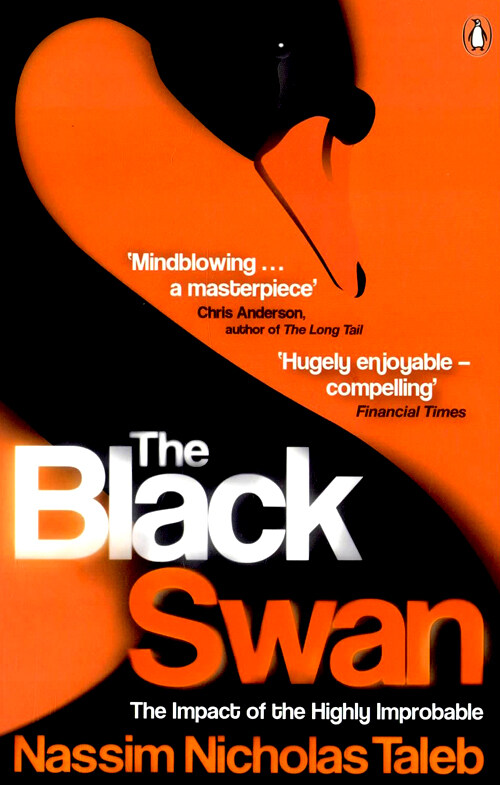
| 245 | 1 4 | ▼a The black swan : ▼b the impact of the highly improbable / ▼c Nassim Nicholas Taleb. |
| 250 | ▼a Rev. ed. | |
| 260 | ▼a London : ▼b Penguin Books, ▼c 2010. | |
| 300 | ▼a xxxiii, 444 p. : ▼b ill. ; ▼c 20 cm. | |
| 504 | ▼a Includes bibliographical references (p. [400]-429) and index. | |
| 505 | 0 | ▼a Prologue -- Umberto Eco's antilibrary, or how we seek validation. The apprenticeship of an empirical skeptic ; Yevgenia's black swan ; The speculator and the prostitute ; One thousand and one days, or how not to be a sucker ; Confirmation shmonfirmation! ; The narrative fallacy ; Living in the antechamber of hope ; Giacomo Casanova's unfailing luck : the problem of silent evidence ; The Ludic fallacy, or the uncertainty of the nerd -- We just can't predict. The scandal of prediction ; How to look for bird poop ; Epistemocracy, a dream ; Appelles the Painter, or what do you do if you cannot predict? -- Those gray swans of Extremistan. From Mediocristan to Extremistan and back ; The bell curve, that great intellectual fraud ; The aesthetics of randomness ; Locke's madmen, or bell curves in the wrong places ; The uncertainty of the phony -- The end. Half and half, or how to get even with the black swan -- Epilogue : Yevgenia's white swans -- Postscript essay: on robustness an fragility, deeper philosophical and empirical reflections. Learning from mother nature, the oldest and the wisest ; Why I do all this walking, or how systems become fragile ; Margaritas ante porcos ; Asperger and the ontological black swan ; (Perhaps) the most useful problem in the history of modern philosophy ; Fourth quadrant, the solution to that most useful of problems ; What to do with the fourth quadrant ; Ten principles for a black-swan-robust society ; Amor fati: how to become indestructible. |
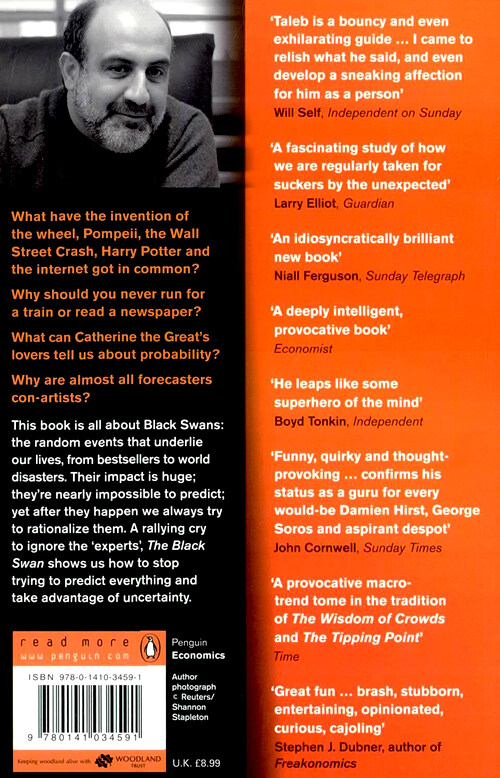
| 520 | ▼a Examines the role of the unexpected, discussing why improbable events are not anticipated or understood properly, and how humans rationalize the black swan phenomenon to make it appear less random. | |
| 650 | 0 | ▼a Uncertainty (Information theory) ▼x Social aspects. |
| 650 | 0 | ▼a Forecasting. |
| 945 | ▼a KLPA |
소장정보
| No. | 소장처 | 청구기호 | 등록번호 | 도서상태 | 반납예정일 | 예약 | 서비스 |
|---|---|---|---|---|---|---|---|
| No. 1 | 소장처 중앙도서관/서고6층/ | 청구기호 003.54 T143b1 | 등록번호 111798589 (3회 대출) | 도서상태 대출가능 | 반납예정일 | 예약 | 서비스 |
컨텐츠정보
책소개
인간의 속성과 현재 세계 금융 위기의 진원지인 월스트리트의 허상을 통렬히 파헤친다. 백조는 흰색이라는 일반적 논리를 깬 검은 백조의 발견 이야기에서 착안된 아이디어로, '검은 백조'는 예측이 불가능하고, 엄청난 충격을 동반한다. 현실로 나타나면 뒤늦게 설명을 시도하여 마치 검은 백조가 설명 가능하고 예견 가능했던 일인 것처럼 여기게 만든다.
구글의 성공, 9·11 테러 등이 대표적인 '검은 백조'다. 저자는 종교의 발생부터 개인의 삶까지 우리 세계의 모든 영역에 '검은 백조'가 잠복해 있다는 것을 밝힌다. 이전에는 미미한 영향을 미쳤던 것들이 이제는 큰 충격을 몰고 온다고 주장하며, 오늘날 더욱 자주 출몰하는 '검은 백조' 현상을 소개한다.
우리가 자신의 무지를 얼마나 모르는지 속속들이 설명하면서, '검은 백조'와 공존하고 이익을 취할 수 있는 간결한 비책을 제시해준다. 또한 모든 부분에 적용할 수 있는 검은백조 아이디어를 사고실험, 인식론, 역사, 경제학, 경영학, 통계학은 물론 프랙탈, 수학, 심리학, 자신의 일화에까지 재치있게 선보인다.
지은이는 우리가 역사와 현재의 사건들을 어떻게 인식하는지, 그 인식에서 어떤 왜곡이 일어나는지를 살펴본다. 또한, 미래를 논할 때 우리가 범하는 오류나 일부 과학의 알려지지 않은 한계점과, 대처방법에 대해 다룬다.
극단적 사건이라는 주제를 좀 더 깊이 살피면서 정규분포곡선이 어떻게 탄생했는지를 살펴보고, 자연과학과 사회과학이 복잡성이라는 이름으로 이런 것들을 어떻게 뭉뚱그리는지 다룬다.
2007년 미국에서 출간된 이래 27개 언어로 번역되었으며, 영국, 이탈리아, 브라질에서도 베스트셀러로 집계되었다.
A black swan is a highly improbable event with three principal characteristics: It is unpredictable; it carries a massive impact; and, after the fact, we concoct an explanation that makes it appear less random, and more predictable, than it was. The astonishing success of Google was a black swan; so was 9/11. For Nassim Nicholas Taleb, black swans underlie almost everything about our world, from the rise of religions to events in our own personal lives. Why do we not acknowledge the phenomenon of black swans until after they occur? Part of the answer, according to Taleb, is that humans are hardwired to learn specifics when they should be focused on generalities. We concentrate on things we already know and time and time again fail to take into consideration what we don’t know. We are, therefore, unable to truly estimate opportunities, too vulnerable to the impulse to simplify, narrate, and categorize, and not open enough to rewarding those who can imagine the “impossible.” For years, Taleb has studied how we fool ourselves into thinking we know more than we actually do. We restrict our thinking to the irrelevant and inconsequential, while large events continue to surprise us and shape our world. In this revelatory book, Taleb explains everything we know about what we don’t know, and this second edition features a new philosophical and empirical essay, “On Robustness and Fragility,” which offers tools to navigate and exploit a Black Swan world. Elegant, startling, and universal in its applications, The Black Swan will change the way you look at the world. Taleb is a vastly entertaining writer, with wit, irreverence, and unusual stories to tell. He has a polymathic command of subjects ranging from cognitive science to business to probability theory. The Black Swan is a landmark book?itself a black swan. Praise for Nassim Nicholas Taleb “The most prophetic voice of all.”?GQ Praise for The Black Swan “[A book] that altered modern thinking.”?The Times (London) “A masterpiece.”?Chris Anderson, editor in chief of Wired, author of The Long Tail “Idiosyncratically brilliant.”?Niall Ferguson, Los Angeles Times “The Black Swan changed my view of how the world works.”?Daniel Kahneman, Nobel laureate “[Taleb writes] in a style that owes as much to Stephen Colbert as it does to Michel de Montaigne. . . . We eagerly romp with him through the follies of confirmation bias [and] narrative fallacy.”?The Wall Street Journal “Hugely enjoyable?compelling . . . easy to dip into.”?Financial Times “Engaging . . . The Black Swan has appealing cheek and admirable ambition.”?The New York Times Book Review
정보제공 :

저자소개
나심 니콜라스 탈레브(지은이)
‘세상에서 가장 유명한 사상가’, ‘월가의 현자’로 묘사되는 나심 탈레브는 현 시대 가장 주목받는 논객으로 꼽힌다. 1960년 레바논에서 태어났으며, 펜실베니아대학교 와튼스쿨에서 경영학 석사를 취득한 후 프랑스 파리 제9대학에서 금융공학 박사학위를 받았다. 이후 21년간 월가의 파생상품 트레이더·위기관리 전문가로 일해오다 확률을 공부하기 시작하며 확률 이론을 통해 철학, 수학, 그리고 세상의 문제들을 해석하게 되었다. 2007년 철학 에세이스트로 전향하여 《블랙 스완》(The Black Swan)을 시작으로 《인세르토》(incerto· 라틴어로 ‘불확실성’을 의미함) 시리즈를 통해 운, 불확실성, 가능성에 관한 철학적이면서도 실질적인 문제 현상들을 다룬 글을 써왔다. 25년간 집필해온 이 시리즈는 전 세계 36개국에 번역·출간되었으며, 다섯 권 모두 화제의 밀리언셀러가 되었다. 현재 뉴욕대학교 폴리테크닉연구소의 리스크공학 특훈교수로, 자신의 연구와 실험을 독자적으로 진행하고 있다. 그의 연구는 불투명성 하에서의 의사결정과 확률의 수학적ㆍ철학적 문제, 다시 말해서 ‘우리가 이해할 수 없는 세상에서 무엇을 할 것인가’에 초점을 맞추고 있다. 특히 인간이 예기치 못한 사건을 이해하고 극복해내는 방식에 대한 독창적이고 대담한 관점을 제시했다. 일찍이 ‘스킨 인 더 게임’이라는 개념을 강조해온 그는 이 책을 통해 궁극적으로 얘기하고자 했던 ‘책임이라는 것은 리스크 관리의 기본이면서, 우리 사회 모든 측면에서 진지하게 다루어져야 하는 가치’라는 메시지를 전한다. 그 외 저서로는 《행운에 속지 마라》(Fooled by Randomness), 《안티프래질》(Antifragile), 《블랙 스완과 함께 가라》(The Bed of Procrustes) 등이 있다.
Nassim Taleb(지은이)