

| 000 | 00000cam u2200205 a 4500 | |
| 001 | 000046031032 | |
| 005 | 20240409140047 | |
| 008 | 200604s2018 mau b 001 0 eng d | |
| 010 | ▼a 2017043529 | |
| 020 | ▼a 9780674980815 (hardcover : alk. paper) | |
| 035 | ▼a (KERIS)REF000018571321 | |
| 040 | ▼a MH/DLC ▼b eng ▼c MH ▼e rda ▼d DLC ▼d 211009 | |
| 050 | 0 0 | ▼a KZ1242 ▼b .P58 2018 |
| 082 | 0 0 | ▼a 341.09 ▼2 23 |
| 084 | ▼a 341.09 ▼2 DDCK | |
| 090 | ▼a 341.09 ▼b P692b | |
| 100 | 1 | ▼a Pitts, Jennifer, ▼d 1970- ▼0 AUTH(211009)162999. |
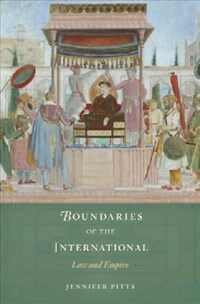
| 245 | 1 0 | ▼a Boundaries of the international : ▼b law and empire / ▼c Jennifer Pitts. |
| 260 | ▼a Cambridge, Massachusetts : ▼b Harvard University Press, ▼c c2018. | |
| 300 | ▼a 293 p. ; ▼c 25 cm. | |
| 504 | ▼a Includes bibliographical references and index. | |
| 505 | 0 | ▼a Introduction : empire and international law -- Oriental despotism and the Ottoman Empire -- Nations and empires in Vattel's world -- Critical legal universalism in the eighteenth century -- The rise of positivism? -- Historicism in Victorian international law. |
| 520 | ▼a Against the dominant narrative first developed in the eighteenth century, which has held that international law had its origins in relations between sovereign European states that respected each other as free and equal, Boundaries of the International examines the deep entanglement of international law with European imperial expansion. As commercial relations with states such as the Ottoman and Empire and China intensified, European legal and political writers increasingly described them as anomalous and backward empires in a modern world of nation-states, even as European states were themselves expanding their imperial reach across the globe. The debate over the boundaries of international law included legal authorities from Vattel to Wheaton to Westlake but ranged well beyond professional jurists to political thinkers such as Montesquieu, Edmund Burke, and J.S. Mill, legislators and diplomats, colonial administrators and journalists. Dissident voices in this broader public debate insisted that European states had extensive legal obligations abroad. These critics provide valuable resources for the critical scrutiny of the political, economic, and legal inequalities that continue to afflict the global order.-- ▼c Provided by publisher | |
| 650 | 0 | ▼a International law ▼x History. |
| 945 | ▼a KLPA |
소장정보
| No. | 소장처 | 청구기호 | 등록번호 | 도서상태 | 반납예정일 | 예약 | 서비스 |
|---|---|---|---|---|---|---|---|
| No. 1 | 소장처 중앙도서관/법학도서실(법학도서관 지하1층)/ | 청구기호 341.09 P692b | 등록번호 111829216 | 도서상태 대출가능 | 반납예정일 | 예약 | 서비스 |
컨텐츠정보
책소개
It is commonly believed that international law originated in relations among European states that respected one another as free and equal. In fact, as Jennifer Pitts shows, international law was forged at least as much through Europeans' domineering relations with non-European states and empires, leaving a legacy still visible in the unequal structures of today's international order.
Pitts focuses on the eighteenth and nineteenth centuries, the great age of imperial expansion, as European intellectuals and administrators worked to establish and justify laws to govern emerging relationships with non-Europeans. Relying on military and commercial dominance, European powers dictated their own terms on the basis of their own norms and interests. Despite claims that the law of nations was a universal system rooted in the values of equality and reciprocity, the laws that came to govern the world were parochial and deeply entangled in imperialism. Legal authorities, including Emer de Vattel, John Westlake, and Henry Wheaton, were key figures in these developments. But ordinary diplomats, colonial administrators, and journalists played their part too, as did some of the greatest political thinkers of the time, among them Montesquieu and John Stuart Mill. Against this growing consensus, however, dissident voices as prominent as Edmund Burke insisted that European states had extensive legal obligations abroad that ought not to be ignored. These critics, Pitts shows, provide valuable resources for scrutiny of the political, economic, and legal inequalities that continue to afflict global affairs.정보제공 :

목차
CONTENTS
ONE : Introduction : Empire and International Law = 1
TWO : Oriental Despotism and the Ottoman Empire = 28
THREE : Nations and Empires in Vattel''''s World = 68
FOUR : Critical Legal Universalism in the Eighteenth Century = 92
FIVE : The Rise of Positivism? = 118
SIX : Historicism in Victorian International Law = 148
Epilogue = 185
Notes = 193
Acknowledgments = 269
Index = 273