

| 000 | 00899pamuu22002894a 4500 | |
| 001 | 000045375068 | |
| 005 | 20070807112729 | |
| 008 | 991104s2000 nyua b 001 0 eng | |
| 010 | ▼a 99057466 | |
| 020 | ▼a 0387989668 (alk. paper) | |
| 020 | ▼a 9780387989662 | |
| 035 | ▼a (KERIS)REF000005327141 | |
| 040 | ▼a DLC ▼c DLC ▼d DLC ▼d 211009 | |
| 042 | ▼a pcc | |
| 050 | 0 0 | ▼a QA76.73.S15 ▼b V46 2000 |
| 082 | 0 0 | ▼a 005.13/3 ▼2 22 |
| 090 | ▼a 005.133 ▼b V447s | |
| 100 | 1 | ▼a Venables, W. N. ▼q (William N.) |
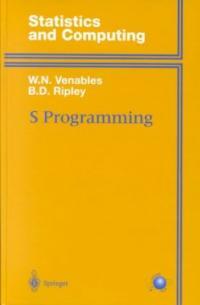
| 245 | 1 0 | ▼a S programming / ▼c W.N. Venables, B.D. Ripley. |
| 260 | ▼a New York : ▼b Springer , ▼c c2000. | |
| 300 | ▼a x, 264 p. : ▼b ill. ; ▼c 24 cm. | |
| 440 | 0 | ▼a Statistics and computing |
| 504 | ▼a Includes bibliographical references and index. | |
| 650 | 0 | ▼a S (Computer program language) |
| 700 | 1 | ▼a Ripley, Brian D. , ▼d 1952- |
| 945 | ▼a KINS |
소장정보
| No. | 소장처 | 청구기호 | 등록번호 | 도서상태 | 반납예정일 | 예약 | 서비스 |
|---|---|---|---|---|---|---|---|
| No. 1 | 소장처 중앙도서관/서고6층/ | 청구기호 005.133 V447s | 등록번호 111427081 (3회 대출) | 도서상태 대출가능 | 반납예정일 | 예약 | 서비스 |
컨텐츠정보
책소개
S is a high-level language for manipulating, analysing and displaying
data. It forms the basis of two highly acclaimed and widely used data
analysis software systems, the commercial S-PLUS® and the Open
Source R. This book provides an in-depth guide to writing software in
the S language under either or both of those systems. It is intended
for readers who have some acquaintance with the S language and want to
know how to use it more effectively, for example to build re-usable
tools for streamlining routine data analysis or to implement new
statistical methods.
One of the outstanding strengths of the S language is the ease with
which it can be extended by users. S is a functional language, and
functions written by users are first-class objects treated in the same
way as functions provided by the system. S code is eminently readable
and so a good way to document precisely what algorithms were used, and
as much of the implementations are themselves written in S, they can be
studied as models and to understand their subtleties. The current
implementations also provide easy ways for S functions to call
compiled code written in C, Fortran and similar languages; this is
documented here in depth.
Increasingly S is being used for statistical or graphical analysis
within larger software systems or for whole vertical-market
applications. The interface facilities are most developed on
Windows® and these are covered with worked examples.
The authors have written the widely used Modern Applied Statistics
with S-PLUS, now in its third edition, and several software libraries
that enhance S-PLUS and R; these and the examples used in both books
are available on the Internet.
Dr. W.N. Venables is a senior Statistician with the CSIRO/CMIS
Environmetrics Project in Australia, having been at the Department of
Statistics, University of Adelaide for many years previously.
Professor B.D. Ripley holds the Chair of Applied Statistics at the
University of Oxford, and is the author of four other books on spatial
statistics, simulation, pattern recognition and neural networks. Both
authors are known and respected throughout the international S and R
communities, for their books, workshops, short courses, freely
available software and through their extensive contributions to the
S-news and R mailing lists.
S is a high-level language for manipulating, analysing and displaying data. It forms the basis of two highly acclaimed and widely used data analysis software systems, the commercial S-PLUS(R) and the Open Source R. This book provides an in-depth guide to writing software in the S language under either or both of those systems. It is intended for readers who have some acquaintance with S language and want to know how to use it more effectively, for example to build re-usable tools for streamlining routine data analysis or to implement new statistical methods. One ofhe most outstanding strengths of the S language is the ease with which it can be extended by users. S is a functional language, and functions written by users are first-class objects treated in the same way as functions provided by the system. S code is eminently readable and so a good way to document precisely what algorithms were used, and as much of the implementations are themselves written in S, they can be studied as models and to understand their subtleties. The current implementations also provide easy ways for S functions to call compiled code written in C, Fortran and similar languages; this is documented here in depth. Increasingly S is being used for statistical or graphical analysis within larger software systems or for whole vertical-market applications. The interface facilities are most developed on Windows(R) and these are covered with worked examples. The authors have written the widely adopted 'Modern Applied Statistics with S-PLUS', now in its third edition, and several software libraries that enhance S-PLUS and R; these and the examples used in both books are available on the Internet. Dr. W.N. Venables is a senior Statistician with the CSIRO/CMIS Environmentrics Project in Autralia, having been at the Department of Statistics, University of Adelaide for many years previously. Professor B.D. Ripley holds the Chair of Applied Statistics at the University of Oxford, and is the author of four other books on spatial statistics, simulation, pattern recognition and neural networks. Both authors are known and respected thorughout the international S and R communities, for their books, workshops, short courses, freely available software and through their extensive contributions to the S-news and R mailing lists.
정보제공 :

목차
Introduction The S Language: Syntax and Semantics The S Language: Advanced Aspects Classes New-style Classes Using Compiled Code General Strategies and Extended Examples S Software Devlopment Interfaces Under Windows
정보제공 :