

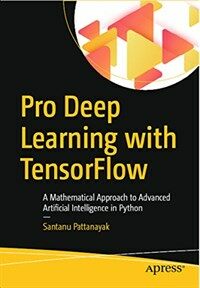
Pro deep learning with TensorFlow : a mathematical approach to advanced artificial intelligence in Python
| 000 | 00000nam u2200205 a 4500 | |
| 001 | 000045936230 | |
| 005 | 20190709115835 | |
| 008 | 180322s2017 caua 001 0 eng d | |
| 020 | ▼a 9781484230954 | |
| 040 | ▼a 211009 ▼c 211009 ▼d 211009 | |
| 082 | 0 4 | ▼a 006.31 ▼2 23 |
| 084 | ▼a 006.31 ▼2 DDCK | |
| 090 | ▼a 006.31 ▼b P315p | |
| 100 | 1 | ▼a Pattanayak, Santanu. |
| 245 | 1 0 | ▼a Pro deep learning with TensorFlow : ▼b a mathematical approach to advanced artificial intelligence in Python / ▼c Santanu Pattanayak. |
| 260 | ▼a [Berkeley, CA] : ▼b Apress, ▼c 2017. | |
| 300 | ▼a xxi, 398 p. : ▼b ill. ; ▼c 26 cm. | |
| 500 | ▼a Includes index. | |
| 505 | 0 | ▼a Chapter 1: Mathematical Foundations -- Chapter 2: Introduction to Deep Learning Concepts and TensorFlow -- Chapter 3: Convolutional Neural Networks -- Chapter 4: Natural Language Processing Using Recursive Neural Networks -- Chapter 5: Unsupervised Learning with Restricted Boltzmann Machines and Auto Encoders -- Chapter 6: Advanced Neural Networks. |
| 630 | 0 0 | ▼a TensorFlow (Electronic resource). |
| 650 | 0 | ▼a Machine learning. |
| 650 | 0 | ▼a Artificial intelligence. |
| 776 | 0 8 | ▼i Online version: ▼a Pattanayak, Santanu. ▼t Pro deep learning with TensorFlow ▼z 9781484230961 ▼w (211009)000045989196 |
| 945 | ▼a KLPA |
소장정보
| No. | 소장처 | 청구기호 | 등록번호 | 도서상태 | 반납예정일 | 예약 | 서비스 |
|---|---|---|---|---|---|---|---|
| No. 1 | 소장처 과학도서관/Sci-Info(2층서고)/ | 청구기호 006.31 P315p | 등록번호 121243867 (11회 대출) | 도서상태 대출가능 | 반납예정일 | 예약 | 서비스 |
컨텐츠정보
책소개
Chapter 1: Machine Learning Basics and Mathematical Foundation for Deep Learning Chapter Goal: Introduce Machine Learning basics and Mathematical Foundations that are associated with Deep Learning No of pages 70-90Sub-Topics1. Linear Algebra basics.2. Numerical Stability and Conditioning.3. Probability.4. Different types of cost functions and introduction to least squares and maximum likelihood methods.5. Convex and Non-convex function 6. Optimization Techniques such as Gradient Descent and Stochastic Gradient Descent as well as Constrained Optimization problems.7. Regularization and Early stopping8. Auto Differentiators and Symbolic Differentiators.
Chapter 2: Introduction to Deep Learning Concepts and TensorFlow Chapter Goal: Introduce Deep Learning concepts and its comparison with previous Neural Networks. Reasons for its success and computational efficiency and a start to TensorFlow Development.No of pages 60-70Sub -Topics 1. Previous Neural Networks and their shortcomings 2. Introduction to Deep Learning Framework and its advantages.3. Why TensorFlow for Deep Learning and its comparison with other Deep Learning Frameworks like Theano, Caffe, Torch, etc.4. Hands on in TensorFlow development environment and introduction to Dynamic Computation graphs. 5. Linear and Logistic regression in a TensorFlow environment6. Feed forward networks through TensorFlow.7. Leveraging GPUs for Computational efficiency.
Chapter 3: Image and Audio Processing in TensorFlow through Convolutional Neural Networks Chapter Goal: Learn to process image and audio data to solve classification, clustering, and recommendation problems using Convolutional Neural Network. No of pages: 70-80Sub - Topics: 1. Convolution and Image processing through Convolution.2. Different Kinds of Image processing filters like Guassian Filter, Sobel Filter, Canny's edge detection filter.3. Different Layers of Convolutional Neural Network - Convolution layer, Pooling Layers, activation layers using RELUs, Dropout layers and fully connected layer. Intuition of features learned in Different layers. Concepts of strides, padding and kernels.4. Solving image classification, clustering and recommendation problems through Convolutional Neural network.5. Feature transfer in Convolutional Neural Network.6. Audio classification problems through Convolutional Neural networks.
Chapter 4: Restricted Boltzmann Deep Learning Architectures through TensorFlow for Various ProblemsChapter Goal: Leverage Restricted Boltzmann Machines (RBMs) for solving Recommendation problems, weight initialization in Deep Learning Networks and for Layer by Layer training of Deep Neural Networks.No of pages:50-60Sub - Topics: 1. Introduction to Restricted Boltzmann Machines (RBMs) and its architecture.2. Using RBMs to build Recommendation engines.3. RBMs for smart weight initialization of Deep Learning Networks.4. Train complex deep learning networks layer by layer (one layer at a time) through RBMs
Chapter 5: Deep Learning for Natural Language Processing through TensorFlow Chapter Goal: Leverage TensorFlow Deep learning capabilities for Natural Language processing No of pages: 50-601. Text processing basics such as Word2Vec Representation, Semantic and Syntactic Analysis. 2. Recurrent Neural network(RNNs) for language modelling through TensorFlow3. Backpropagation through time and problems of Vanishing and Exploding gra
정보제공 :

저자소개
산타누 파타나야크(지은이)
현재 GE에서 수석 데이터 과학자로 근무하고 있다. 데이터 분석 및 데이터 과학 분야에서 쌓은 6년의 경력을 비롯해 총 10년 동안 이 분야에서 근무했다. 또한 개발과 데이터베이스 기술 분야도 경험했다. GE에 입사하기 전에는 RBS, 캡게미니(Capgemini), IBM 등의 회사에서 근무했다. 인도의 콜카타 자다브푸르 대학에서 전기공학 학사를 받았고, 열렬한 수학 애호가다. 현재는 하이데라바드 소재 인도 기술연구소(IIT)에서 데이터 과학 석사 과정을 밟고 있다. 데이터 과학 해커톤(hackathon)과 캐글(Kaggle) 경연 대회에 참가하는 데 많은 시간을 투자하고 있으며, 전 세계 500등 이내에 위치한다. 인도의 웨스트 벵갈에서 태어나고 자랐으며, 현재 인도 벵갈루루에서 아내와 함께 살고 있다. http://www.santanupattanayak.com/에서 최근 활동을 확인할 수 있다.
목차
Chapter 1: Mathematical Foundations
Chapter 2: Introduction to Deep Learning Concepts and TensorFlow
Chapter 3: Convolutional Neural Networks
Chapter 4: Natural Language Processing Using Recursive Neural Networks
Chapter 5: Unsupervised Learning with Restricted Boltzmann Machines and Auto Encoders
Chapter 6: Advanced Neural Networks.