

| 000 | 00000cam u2200205 a 4500 | |
| 001 | 000046155593 | |
| 005 | 20230804115252 | |
| 008 | 230803t20212020nyu b 001 0 eng d | |
| 020 | ▼a 9780393868333 ▼q (paperback) | |
| 020 | ▼a 0393868338 ▼q (paperback) | |
| 035 | ▼a (KERIS)REF000020082585 | |
| 040 | ▼a YDX ▼b eng ▼c YDX ▼d BDX ▼d IBI ▼d OCLCF ▼d OCLCO ▼d 211009 | |
| 050 | 4 | ▼a Q334.7 ▼b .C47 2021 |
| 082 | 0 4 | ▼a 174/.90063 ▼2 23 |
| 084 | ▼a 174.90063 ▼2 DDCK | |
| 090 | ▼a 174.90063 ▼b C555a | |
| 100 | 1 | ▼a Christian, Brian, ▼d 1984- ▼0 AUTH(211009)65655. |
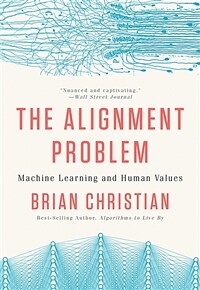
| 245 | 1 4 | ▼a The alignment problem : ▼b machine learning and human values / ▼c Brian Christian. |
| 246 | 3 0 | ▼a Machine learning and human values |
| 260 | ▼a New York, NY : ▼b W.W. Norton & Company, ▼c 2021, c2020. | |
| 264 | 1 | ▼a New York, NY : ▼b W.W. Norton & Company, ▼c [2021] |
| 264 | 4 | ▼c ©2020 |
| 300 | ▼a xvi, 476 p. ; ▼c 21 cm. | |
| 336 | ▼a text ▼b txt ▼2 rdacontent | |
| 337 | ▼a unmediated ▼b n ▼2 rdamedia | |
| 338 | ▼a volume ▼b nc ▼2 rdacarrier | |
| 386 | ▼m Gender group: ▼n gdr ▼a Men ▼2 lcdgt | |
| 386 | ▼m Nationality/regional group: ▼n nat ▼a Californians ▼2 lcdgt | |
| 386 | ▼m Occupational/field of activity group: ▼n occ ▼a Scholars ▼2 lcdgt | |
| 504 | ▼a Includes bibliographical references (p. [401]-451) and index. | |
| 505 | 0 0 | ▼g I. ▼t PROPHECY. -- ▼g 1. ▼t Representation -- ▼g 2. ▼t Fairness -- ▼g 3. ▼t Transparency -- ▼g II. ▼t AGENCY. -- ▼g 4. ▼t Reinforcement -- ▼g 5. ▼t Shaping -- ▼g 6. ▼t Curiosity -- ▼g III. ▼t NORMATIVITY. -- ▼g 7. ▼t Imitation -- ▼g 8. ▼t Inference -- ▼g 9. ▼t Uncertainty -- Conclusion. |
| 520 | ▼a "A jaw-dropping exploration of everything that goes wrong when we build AI systems-and the movement to fix them. Today's "machine-learning" systems, trained by data, are so effective that we've invited them to see and hear for us-and to make decisions on our behalf. But alarm bells are ringing. Systems cull résumés until, years later, we discover that they have inherent gender biases. Algorithms decide bail and parole-and appear to assess black and white defendants differently. We can no longer assume that our mortgage application, or even our medical tests, will be seen by human eyes. And autonomous vehicles on our streets can injure or kill. When systems we attempt to teach will not, in the end, do what we want or what we expect, ethical and potentially existential risks emerge. Researchers call this the alignment problem. In best-selling author Brian Christian's riveting account, we meet the alignment problem's "first-responders," and learn their ambitious plan to solve it before our hands are completely off the wheel"--Provided by publisher. | |
| 650 | 0 | ▼a Artificial intelligence ▼x Moral and ethical aspects. |
| 650 | 0 | ▼a Artificial intelligence ▼x Social aspects. |
| 650 | 0 | ▼a Machine learning ▼x Safety measures. |
| 650 | 0 | ▼a Software failures. |
| 650 | 0 | ▼a Social values. |
| 945 | ▼a ITMT |
소장정보
| No. | 소장처 | 청구기호 | 등록번호 | 도서상태 | 반납예정일 | 예약 | 서비스 |
|---|---|---|---|---|---|---|---|
| No. 1 | 소장처 중앙도서관/서고6층/ | 청구기호 174.90063 C555a | 등록번호 111883495 (1회 대출) | 도서상태 대출가능 | 반납예정일 | 예약 | 서비스 |
컨텐츠정보
책소개
Today's "machine-learning" systems, trained by data, are so effective that we've invited them to see and hear for us--and to make decisions on our behalf. But alarm bells are ringing. Recent years have seen an eruption of concern as the field of machine learning advances. When the systems we attempt to teach will not, in the end, do what we want or what we expect, ethical and potentially existential risks emerge. Researchers call this the alignment problem.
Systems cull r?sum?s until, years later, we discover that they have inherent gender biases. Algorithms decide bail and parole--and appear to assess Black and White defendants differently. We can no longer assume that our mortgage application, or even our medical tests, will be seen by human eyes. And as autonomous vehicles share our streets, we are increasingly putting our lives in their hands.
The mathematical and computational models driving these changes range in complexity from something that can fit on a spreadsheet to a complex system that might credibly be called "artificial intelligence." They are steadily replacing both human judgment and explicitly programmed software.
In best-selling author Brian Christian's riveting account, we meet the alignment problem's "first-responders," and learn their ambitious plan to solve it before our hands are completely off the wheel. In a masterful blend of history and on-the ground reporting, Christian traces the explosive growth in the field of machine learning and surveys its current, sprawling frontier. Readers encounter a discipline finding its legs amid exhilarating and sometimes terrifying progress. Whether they--and we--succeed or fail in solving the alignment problem will be a defining human story.
The Alignment Problem offers an unflinching reckoning with humanity's biases and blind spots, our own unstated assumptions and often contradictory goals. A dazzlingly interdisciplinary work, it takes a hard look not only at our technology but at our culture--and finds a story by turns harrowing and hopeful.
정보제공 :

저자소개
브라이언 크리스천(지은이)
브라운대에서 컴퓨터과학과 철학을 공부하고 워싱턴대에서 문학 석사 학위를 받았다. 기술과 사회, 문화, 인공지능 및 심리 분야의 저술가로 촉망받고 있다. 구글, 마이크로소프트, 런던정치경제대 등에서 강의한 바 있으며 〈월스트리트저널〉, 〈가디언〉, 〈와이어드〉 등의 대중매체와 〈인지과학〉, 〈파리 리뷰〉를 비롯한 전문 저널에도 기고 중이다. 우리나라에 번역된 저서로는 《알고리즘, 인생을 계산하다》가 있다.
목차
Prologue 1

Introduction 5

I Prophecy

1 Representation 17

2 Fairness 51

3 Transparency 82

II Agency

4 Reinforcement 121

5 Shaping 152

6 Curiosity 181

III Normativity

7 Imitation 213

8 Inference 251

9 Uncertainty 277

Conclusion 311

Acknowledgments 331

Notes 335

Bibliography 401

Index 453