

| 000 | 00988camuu2200301 a 4500 | |
| 001 | 000000700830 | |
| 005 | 20010410154050 | |
| 008 | 981110s1999 nyua b 001 0 eng | |
| 010 | ▼a 98051035 | |
| 020 | ▼a 0471327352 (cloth : alk. paper) | |
| 040 | ▼a DLC ▼c DLC ▼d UKM ▼d C#P ▼d 211009 | |
| 043 | ▼a n-us--- | |
| 049 | 1 | ▼l 111181955 |
| 050 | 0 0 | ▼a HG4915 ▼b .C664 1999 |
| 082 | 0 0 | ▼a 332.63/22/0973 ▼2 21 |
| 090 | ▼a 332.6322 ▼b C814e | |
| 100 | 1 | ▼a Cornell, Bradford. |
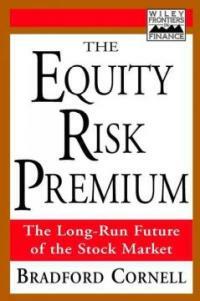
| 245 | 1 4 | ▼a The equity risk premium : ▼b the long-run future of the stock market / ▼c Bradford Cornell. |
| 260 | ▼a New York : ▼b Wiley, ▼c c1999. | |
| 300 | ▼a x, 227 p. : ▼b ill. ; ▼c 24 cm. | |
| 440 | 0 | ▼a Wiley frontiers in finance |
| 504 | ▼a Includes bibliographical references (p. [217]-222) and index. | |
| 650 | 0 | ▼a Stocks ▼x Prices ▼z United States. |
| 650 | 0 | ▼a Risk ▼z United States. |
| 650 | 4 | ▼a Stocks. |
| 650 | 4 | ▼a Speculation. |
| 650 | 4 | ▼a Government securities. |
소장정보
| No. | 소장처 | 청구기호 | 등록번호 | 도서상태 | 반납예정일 | 예약 | 서비스 |
|---|---|---|---|---|---|---|---|
| No. 1 | 소장처 중앙도서관/서고6층/ | 청구기호 332.6322 C814e | 등록번호 111181955 (4회 대출) | 도서상태 대출가능 | 반납예정일 | 예약 | 서비스 |
컨텐츠정보
책소개
The Equity Risk Premium-the difference between the rate of return on common stock and the return on government securities-has been widely recognized as the key to forecasting future returns on the stock market. Though relatively simple in theory, understanding and making practical use of the equity risk premium concept has been dauntingly complex-until now.
In The Equity Risk Premium, financial advisor, author, and scholar Bradford Cornell makes accessible for the first time an authoritative explanation of the equity risk premium and how it works in the real world. Step-by-step, his lucid, nontechnical presentation leads the reader to a new and more enlightened basis for making asset allocation choices.
Cornell begins his analysis by looking at the equity risk premium in the light of stock market history. He examines the use of historical data in estimating future stock market performance, including the historical relationship between stock returns and risk premium, the impact of survival bias, and the effect of long-horizon stock and bond returns. Using the stock market boom of the 1990s as a case study, Cornell demonstrates what equity risk premium analysis can tell us about whether stock prices are high or low, whether the stock market itself may have changed, and whether indeed a new economic paradigm of higher earnings and dividend growth is now in place.
Cornell analyzes forward-looking estimates of the equity risk premium through the lens of various competing approaches and assesses the relative merits of each. Among those scrutinized are the Discounted Cash Flow model, the Kaplan-Rubeck study, the Welch survey, and the Fama-French Aggregate IRR analysis. His insights on risk aversion theory, on the types of risk that have been rewarded over time, and on changing investor demographics all supply the sophisticated investor with important pieces of the risk premium puzzle.
In his invaluable summing up of the equity risk premium and the long-run outlook for common stocks, Cornell weighs the evidence and assays the impact of a lower equity risk premium in the future-and its profound implications for investments, corporate decision making, and retirement planning.
The product of years of serious analysis and hard-won insights, The Equity Risk Premium is essential reading for institutional investors, money managers, corporate financial officers, and all others who require a higher level of market analysis.
"The Equity Risk Premium plays a critical role in legal and regulatory matters related to corporate finance. Along with the cost of debt, it is the most important determinant of a company's cost of capital. As such, it is an integral part of the decision-making process in corporate finance. For instance, whether or not a major acquisition makes sense can depend on the assumed value of the equity risk premium. In addition, the equity risk premium is an issue that regulatory bodies consider when they set fair rates of return for regulated companies. Cornell's book is an important contribution because it includes both an historical analysis of the equity risk premium and provides tools for forecasting reasonable levels of the risk premium in the years ahead."-Theodore N. Miller, Partner, Sidley & Austin.
"Estimating how well stocks will do in the future from how well they have done in the past is like driving a car while looking in the rearview mirror. Brad Cornell provides us with an important forward-looking view in this easily understood guide to the equity risk premium and confounds the popular view that stocks will do well in the future because they have done well in the past."-Michael Brennan, Past President of the American Finance Association and Professor of Finance at the University of California at Los Angeles.
New feature
The Equity Risk Premium-the difference between the rate of return on common stock and the return on government securities-has been widely recognized as the key to forecasting future returns on the stock market. Though relatively simple in theory, understanding and making practical use of the equity risk premium concept has been dauntingly complex-until now.In The Equity Risk Premium, financial advisor, author, and scholar Bradford Cornell makes accessible for the first time an authoritative explanation of the equity risk premium and how it works in the real world. Step-by-step, his lucid, nontechnical presentation leads the reader to a new and more enlightened basis for making asset allocation choices.
Cornell begins his analysis by looking at the equity risk premium in the light of stock market history. He examines the use of historical data in estimating future stock market performance, including the historical relationship between stock returns and risk premium, the impact of survival bias, and the effect of long-horizon stock and bond returns. Using the stock market boom of the 1990s as a case study, Cornell demonstrates what equity risk premium analysis can tell us about whether stock prices are high or low, whether the stock market itself may have changed, and whether indeed a new economic paradigm of higher earnings and dividend growth is now in place.
Cornell analyzes forward-looking estimates of the equity risk premium through the lens of various competing approaches and assesses the relative merits of each. Among those scrutinized are the Discounted Cash Flow model, the Kaplan-Rubeck study, the Welch survey, and the Fama-French Aggregate IRR analysis. His insights on risk aversion theory, on the types of risk that have been rewarded over time, and on changing investor demographics all supply the sophisticated investor with important pieces of the risk premium puzzle.
In his invaluable summing up of the equity risk premium and the long-run outlook for common stocks, Cornell weighs the evidence and assays the impact of a lower equity risk premium in the future-and its profound implications for investments, corporate decision making, and retirement planning.
The product of years of serious analysis and hard-won insights, The Equity Risk Premium is essential reading for institutional investors, money managers, corporate financial officers, and all others who require a higher level of market analysis.
"The Equity Risk Premium plays a critical role in legal and regulatory matters related to corporate finance. Along with the cost of debt, it is the most important determinant of a company's cost of capital. As such, it is an integral part of the decision-making process in corporate finance. For instance, whether or not a major acquisition makes sense can depend on the assumed value of the equity risk premium. In addition, the equity risk premium is an issue that regulatory bodies consider when they set fair rates of return for regulated companies. Cornell's book is an important contribution because it includes both an historical analysis of the equity risk premium and provides tools for forecasting reasonable levels of the risk premium in the years ahead."-Theodore N. Miller, Partner, Sidley & Austin.
"Estimating how well stocks will do in the future from how well they have done in the past is like driving a car while looking in the rearview mirror. Brad Cornell provides us with an important forward-looking view in this easily understood guide to the equity risk premium and confounds the popular view that stocks will do well in the future because they have done well in the past."-Michael Brennan, Past President of the American Finance Association and Professor of Finance at the University of California at Los Angeles.
정보제공 :

목차
CONTENTS

Preface = ⅸ

Acknowledgments = xi

Chapter 1 : Measuring and Assessing Stock-Market Performance = 1

 An Introduction to Stock-Market History = 5

  Stock-Market Indexes = 6

  Using Investor Returns to Assess Stock-Market Performance = 9

  An Overview of Market Performance : Annual Holding - Period Returns = 12

 The Equity Risk Premium = 18

  Definition = 18

  Importance = 19

 Using the Historical Data to Estimate Future Stock-Market Performance = 20

  Uses of the Equity Risk Premium = 27

  Inflation and Asset Returns = 29

  Stock Returns and the Risk Premium : Looking Forward = 34

Chapter 2 : Evaluating the Historical Record = 36

 Computing the Average Premium : Arithmetic versus Geometric = 36

 How Accurately Can the Historical Risk Premium Be Measured? = 39

 Nonstationarity and Historical Estimates of the Equity Risk Premium = 45

 Attempts to Model Changes in the Risk Premium = 49

  Models Based on the Variability of Returns = 51

  Models Based on Dividend and Earnings Yield = 52

  Does Nonstationarity Really Matter for Estimating the Long-Run Risk Premium? = 53

  The Impact of Permanent Changes in the Risk Premium on Stock Prices = 55

  The Bottom Line on Nonstationarity = 59

 Survival Bias = 60

  The Impact = 60

  The Bottom Line = 69

 Stock and Bond Returns = 70

  Over the Long Horizon = 70

  The Impact of Inflation = 74

 A Final Assessment of the Historical Record = 77

 Appendix 2.1 : Monthly Data for Stocks, Bonds, Bills, and Inflation = 79

Chapter 3 : Forward-Looking Estimates of the Equity Risk Premium = 101

 The Discounted Cash Flow Model = 102

  Forms of the Model = 102

   Constant- Growth Form = 102

   Multistage Form = 106

  Comparison of the Discounted Cash Flow and Historical Estimates of the Risk Premium = 113

 The Blanchard Extension of the Discounted Cash Flow Approach = 114

 The Kaplan-Ruback Study = 115

 The Fama-French Aggregate Internal Rate of Return Analysis = 117

 An Earnings Yield Approach to Estimating the Market Risk Premium = 121

 The Welch Survey = 122

 Summary of the Risk Premium Estimates Produced by Competing Approaches = 125

Chapter 4 : Risk Aversion and the Risk Premium Puzzle = 126

 The Economic Theory of Risk Aversion = 126

 What Types of Risk Are Rewarded : A Brief Review of Portfolio Theory = 130

 The Market Risk Premium and the Cost of Equity Capital = 135

 Risk Aversion and the Historical Equity Risk Premium : The Risk Premium Puzzle = 137

 Explanations for the Risk Premium Puzzle

  The Puzzle Is an Illusion : The Empirical Data Are Wrong = 141

  High Risk Aversion = 142

  Nonstandard Utility Functions = 145

  Autocorrelation in Returns = 149

  Time Varies Expected Returns = 150

  Heterogeneous Investors = 151

  What about a Stew? = 154

 What Explanations of the Equity Risk Premium Say about the Future = 154

Chapter 5 : The Risk Premium and the Stock-Market Boom of the 1990s = 158

 Determining Whether Stock Prices Are High or Low = 159

 Explanations for the High Level of Stock Prices = 164

  A Decline in the Discount Rate Due to a Drop in the Equity Risk Premium = 165

  Changing Stock-Market Risk = 168

  Changing Investors and Changing Investor Demographics = 170

  The New Economic Paradigm : Higher Earnings and Dividend Growth = 178

  Irrational Exuberance : The Market Is Overvalued = 183

 Summary = 194

 Appendix 5.1 : International Stock Market Indices = 196

Chapter 6 : The Equity Risk Premium and the Long-Run Outlook for Common Stocks = 201

 Weighing the Empirical and Theoretical Evidence = 202

 What Does the Stock Price Run-Up of the 1990s Augur for the Future? = 206

  The Impact of a Rational Drop in the Equity Risk Premium = 206

  The Impact of Permanently Higher Growth = 210

  The Implications of Overvaluation = 211

  Summary = 213

 Implications of a Lower Equity Risk Premium in the Future = 213

  Investment Implications = 213

  Implications for Corporate Financial Decision Making = 215

  Implications for Pension and Retirement Planning = 216

References = 217

Index = 223