

| 000 | 01333camuu2200265 a 4500 | |
| 001 | 000045482335 | |
| 005 | 20081104170017 | |
| 008 | 070914s2007 njua 001 0 eng | |
| 010 | ▼a 2007038103 | |
| 020 | ▼a 9780471789086 (paper/cd-rom) | |
| 035 | ▼a (KERIS)REF000013611710 | |
| 040 | ▼a DLC ▼c DLC ▼d DLC ▼d 211009 | |
| 050 | 0 0 | ▼a HG106 ▼b .S458 2007 |
| 082 | 0 0 | ▼a 332.0285/5362 ▼2 22 |
| 090 | ▼a 332.0285 ▼b S476f | |
| 100 | 1 | ▼a Sengupta, Chandan. |
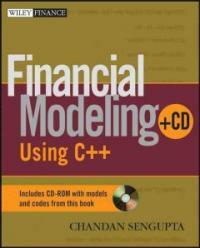
| 245 | 1 0 | ▼a Financial modeling using C++ (+ CD) / ▼c Chandan Sengupta. |
| 260 | ▼a Hoboken, N.J. : ▼b J. Wiley & Sons , ▼c c2007. | |
| 300 | ▼a ix, 565 p. : ▼b ill. ; ▼c 24 cm. + ▼e 1 CD-ROM (4 3/4 in.). | |
| 500 | ▼a Includes index. | |
| 505 | 0 | ▼a Overview of programming and C++ -- A first look at C++ -- Variables, constants, and arrays -- Operators -- Inputs and outputs -- Program flow control: branching -- Program flow control : looping -- Functions -- Strings -- Pointers -- Debugging -- The model development process -- Time value of money -- Options and the Black-Scholes model -- Binomial trees -- Simulations -- Overview of advanced C++ -- Class and encapsulation -- Inheritance -- Polymorphism -- Templates and vectors. |
| 650 | 0 | ▼a Finance ▼x Mathematical models. |
| 650 | 0 | ▼a C++ (Computer program language) |
| 945 | ▼a KINS |
소장정보
| No. | 소장처 | 청구기호 | 등록번호 | 도서상태 | 반납예정일 | 예약 | 서비스 |
|---|---|---|---|---|---|---|---|
| No. 1 | 소장처 과학도서관/Sci-Info(2층서고)/ | 청구기호 332.0285 S476f | 등록번호 121178565 (8회 대출) | 도서상태 대출가능 | 반납예정일 | 예약 | 서비스 |
컨텐츠정보
책소개
A detailed look at developing real-world financial models using C++
This book, designed for self-study, reference, and classroom use, outlines a comprehensive approach to creating both simple and advanced financial models using C++. Author and modeling expert Chandan Sengupta covers programming, the C++ language, and financial modeling from the ground up-assuming no prior knowledge in these areas-and shows through numerous examples how to combine these skills with financial theory and mathematics to develop practical financial models. Since C++ is the computer language used most often to develop large-scale financial models and systems, readers will find this work-which includes a CD-ROM containing the models and codes from the book-an essential asset in their current modeling endeavors.
Chandan Sengupta (White Plains, NY) teaches finance in the MBA program at the Fordham University Graduate School of Business. He is also the author of Financial Modeling Using Excel and VBA (0-471-26768-6).
New feature
Praise for Financial Modeling Using C++
“Financial Modeling Using C++ will have universal appeal for anyone interested in unlocking the power of the C++ language within the context of financial modeling. It is approachable for those with no skill in computer programming and provides excellent insight into proper programming techniques. The language is taught simultaneously within the framework of mainstream financial modeling tasks that are covered in detail and in steps that build off of each other. This book is a valuable introduction to both C++ and financial modeling, and also provides robust example code that can instantly be used and built upon to complete advanced analyses.”
—Keith A. Allman, Principal, Enstruct Corp.
“Financial analysts and others seeking to move beyond spreadsheet modeling will find this book most useful. Professor Sengupta begins at ‘step zero’ of C++ and takes the reader artfully through advanced programming concepts that are essential for building large-scale financial models. This is a wonderful book for learning to program in C++ and to have on hand as a reference.”
—John Charnes, Professor and Scupin Faculty Fellow, The University of Kansas School of Business, and author of Financial Modeling with Crystal Ball and Excel
Computerized financial models now form the backbone of most practical applications of finance, and C++ is the preeminent computer language for building powerful and complex financial models. This book starts by teaching both computer programming and the C++ language assuming no prior knowledge of either. It then walks you through building increasingly complex real-life financial models using basic to advanced C++, including its Object-Oriented Programming features. Chandan Sengupta’s step-by-step approach makes this book ideal for both self-study and classroom use. In addition, discussions of the key elements of the C++ language—and the availability of the complete codes of all the models in the book—make it a useful reference for developers.
정보제공 :

목차
Chapter 1. Introduction.
Part I. Essential C++.
Chapter 2. Overview of Programming and C++.
Chapter 3. A First Look at C++.
Chapter 4. Variables, Constants, and Arrays.
Chapter 5. Operators.
Chapter 6. Inputs and Outputs.
Chapter 7. Program Flow Control: Branching.
Chapter 8. Program Flow Control: Looping.
Chapter 9. Functions.
Chapter 10. Strings.
Chapter 11. Pointers.
Chapter 12. Debugging.
Part II. Modeling Using Essential C++.
Chapter 13. The Model Development Process.
Chapter 14. Time Value of Money.
Chapter 15. Options and the Black-Scholes Model.
Chapter 16. Binomial Trees.
Chapter 17. Simulations.
Part III. Modeling Using Advanced C++.
Chapter 18. Overview of Advanced C++.
Chapter 19. Class and Encapsulation.
Chapter 20. Inheritance.
Chapter 21. Polymorphism.
Chapter 22. Templates and Vectors.
Appendix A. C++ Keywords.
Appendix B. Selected Standard Library Functions.
Recommended Books.
정보제공 :