

| 000 | 00000cam u2200205 a 4500 | |
| 001 | 000045948501 | |
| 005 | 20180726155837 | |
| 008 | 180726s2018 enka 001 0 eng d | |
| 020 | ▼a 9781788624336 | |
| 020 | ▼a 1788624335 | |
| 035 | ▼a (KERIS)BIB000014803139 | |
| 040 | ▼a 211046 ▼c 211046 ▼d 211009 | |
| 082 | 0 4 | ▼a 006.32 ▼2 23 |
| 084 | ▼a 006.32 ▼2 DDCK | |
| 090 | ▼a 006.32 ▼b S941d | |
| 100 | 1 | ▼a Subramanian, Vishnu. |
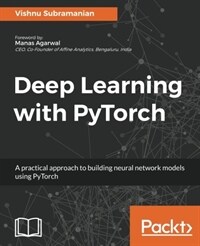
| 245 | 1 0 | ▼a Deep learning with PyTorch : ▼b a practical approach to building neural network models using PyTorch / ▼c Vishnu Subramanian. |
| 260 | ▼a Birmingham : ▼b Packt Publishing, ▼c c2018. | |
| 300 | ▼a vii, 243 p. : ▼b ill. ; ▼c 24 cm. | |
| 500 | ▼a Includes index. | |
| 520 | ▼a This book provides the intuition behind the state of the art Deep Learning architectures such as ResNet, DenseNet, Inception, and encoder-decoder without diving deep into the math of it. It shows how you can implement and use various architectures to solve problems in the area of image classification, language translation and NLP using PyTorch. | |
| 650 | 0 | ▼a Neural networks (Computer science). |
| 650 | 0 | ▼a Machine learning. |
| 650 | 0 | ▼a Python (Computer program language). |
| 945 | ▼a KLPA |
소장정보
| No. | 소장처 | 청구기호 | 등록번호 | 도서상태 | 반납예정일 | 예약 | 서비스 |
|---|---|---|---|---|---|---|---|
| No. 1 | 소장처 과학도서관/Sci-Info(2층서고)/ | 청구기호 006.32 S941d | 등록번호 121245403 (15회 대출) | 도서상태 대출가능 | 반납예정일 | 예약 | 서비스 |
컨텐츠정보
책소개
Build neural network models in text, vision and advanced analytics using PyTorch
Key Features
- Learn PyTorch for implementing cutting-edge deep learning algorithms.
- Train your neural networks for higher speed and flexibility and learn how to implement them in various scenarios;
- Cover various advanced neural network architecture such as ResNet, Inception, DenseNet and more with practical examples;
Book Description
Deep learning powers the most intelligent systems in the world, such as Google Voice, Siri, and Alexa. Advancements in powerful hardware, such as GPUs, software frameworks such as PyTorch, Keras, Tensorflow, and CNTK along with the availability of big data have made it easier to implement solutions to problems in the areas of text, vision, and advanced analytics.
This book will get you up and running with one of the most cutting-edge deep learning libraries-PyTorch. PyTorch is grabbing the attention of deep learning researchers and data science professionals due to its accessibility, efficiency and being more native to Python way of development. You'll start off by installing PyTorch, then quickly move on to learn various fundamental blocks that power modern deep learning. You will also learn how to use CNN, RNN, LSTM and other networks to solve real-world problems. This book explains the concepts of various state-of-the-art deep learning architectures, such as ResNet, DenseNet, Inception, and Seq2Seq, without diving deep into the math behind them. You will also learn about GPU computing during the course of the book. You will see how to train a model with PyTorch and dive into complex neural networks such as generative networks for producing text and images.
By the end of the book, you'll be able to implement deep learning applications in PyTorch with ease.
What you will learn
- Use PyTorch for GPU-accelerated tensor computations
- Build custom datasets and data loaders for images and test the models using torchvision and torchtext
- Build an image classifier by implementing CNN architectures using PyTorch
- Build systems that do text classification and language modeling using RNN, LSTM, and GRU
- Learn advanced CNN architectures such as ResNet, Inception, Densenet, and learn how to use them for transfer learning
- Learn how to mix multiple models for a powerful ensemble model
- Generate new images using GAN's and generate artistic images using style transfer
Who This Book Is For
This book is for machine learning engineers, data analysts, data scientists interested in deep learning and are looking to explore implementing advanced algorithms in PyTorch. Some knowledge of machine learning is helpful but not a mandatory need. Working knowledge of Python programming is expected.
Table of Contents
- Getting Started with Pytorch for Deep Learning
- Mathematical building blocks of Neural Networks
- Getting Started with Neural Networks
- Fundamentals of Machine Learning
- Deep Learning for Computer Vision
- Natural Language Processing for PyTorch
- Advanced neural network architectures
- Generative networks
- Conclusion
정보제공 :

저자소개
비슈누 수브라마니안(지은이)
다수의 빅데이터 분석 프로젝트(인공지능, 머신 러닝 및 딥러닝)에서 프로젝트 리딩, 설계 및 구현 역할을 담당했다. 머신 러닝, 딥러닝, 분산 환경 머신 러닝 및 시각화에 전문성을 갖 고 있다. 유통, 금융 및 여행 분야에서 경험을 쌓았다. 비지니스, 인공지능 그리고 엔지니어 팀 간의 이해와 소통을 돕고 조정하는 데 능숙하다.
목차
CONTENTS
Preface = 1
Chapter 1 Getting Started with Deep Learning Using PyTorch = 7
 Artificial intelligence = 8
  The history of AI = 8
 Machine learning = 9
  Examples of machine learning in real life = 10
 Deep learning = 10
  Applications of deep learning = 11
  Hype associated with deep learning = 13
  The history of deep learning = 14
  Why now? = 14
  Hardware availability = 14
  Data and algorithms = 16
  Deep learning frameworks = 16
 Summary = 18
Chapter 2 Building Blocks of Neural Networks = 19
 Installing PyTorch = 19
 Our first neural network = 20
  Data preparation = 21
  Creating data for our neural network = 31
  Loading data = 35
 Summary = 37
Chapter 3 Diving Deep into Neural Networks = 39
 Deep dive into the building blocks of neural networks = 39
  Layers - fundamental blocks of neural networks = 41
  Non-linear activations = 43
  PyTorch non-linear activations = 47
  Image classification using deep learning = 52
 Summary = 64
Chapter 4 Fundamentals of Machine Learning = 65
 Three kinds of machine learning problems = 65
  Supervised learning = 66
  Unsupervised learning = 66
  Reinforcement learning = 67
 Machine learning glossary = 67
 Evaluating machine learning models = 68
  Training, validation, and test split = 69
 Data preprocessing and feature engineering = 73
  Vectorization = 73
  Value normalization = 73
  Handling missing values = 74
  Feature engineering = 74
 Overfitting and underfitting = 75
  Getting more data = 76
  Reducing the size of the network = 76
  Applying weight regularization = 77
  Dropout = 78
  Underfitting = 80
 Workflow of a machine learning project = 80
  Problem definition and dataset creation = 80
  Measure of success = 81
  Evaluation protocol = 82
  Prepare your data = 82
  Baseline model = 82
  Large model enough to overfit = 83
  Applying regularization = 84
  Learning rate picking strategies = 85
 Summary = 86
Chapter 5 Deep Learning for Computer Vision = 87
 Introduction to neural networks = 88
  MNIST - getting data = 89
 Building a CNN model from scratch = 91
  Conv2d = 93
  Pooling = 97
  Nonlinear activation - ReLU = 99
  View = 99
  Training the model = 101
  Classifying dogs and cats - CNN from scratch = 104
  Classifying dogs and cats using transfer learning = 106
 Creating and exploring a VGG16 model = 108
  Freezing the layers = 110
  Fine-tuning VGG16 = 110
  Training the VGG16 model = 110
 Calculating pre-convoluted features = 113
 Understanding what a CNN model learns = 116
  Visualizing outputs from intermediate layers = 116
 Visualizing weights of the CNN layer = 121
 Summary = 121
Chapter 6 Deep Learning with Sequence Data and Text = 123
 Working with text data = 124
  Tokenization = 125
  Vectorization = 128
 Training word embeddingby building a sentiment classifier = 132
  Downloading IMDB data and performing text tokenization = 133
  Building vocabulary = 135
  Generate batches of vectors = 136
  Creating a network model with embedding = 137
  Training the model = 138
 Using pretrained word embeddings = 140
  Downloading the embeddings = 140
  Loading the embeddings in the model = 141
  Freeze the embedding layer weights = 142
 Recursive neural networks = 143
  Understanding how RNN works with an example = 144
 LSTM = 147
  Long-term dependency = 147
  LSTM networks = 147
 Convolutional network on sequence data = 153
  Understanding one-dimensional convolution for sequence data = 154
 Summary = 156
Chapter 7 Generative Networks = 157
 Neural style transfer = 158
  Loading the data = 160
  Creating the VGG model = 162
  Content loss = 163
  Style loss = 163
  Extracting the losses = 166
  Creating loss function for each layers = 169
  Creating the optimizer = 169
  Training = 170
 Generative adversarial networks = 171
 Deep convolutional GAN = 173
  Defining the generator network = 173
  Defining the discriminator network = 178
  Defining loss and optimizer = 179
  Training the discriminator = 180
  Training the generator network = 181
  Training the complete network = 181
  Inspecting the generated images = 183
 Language modeling = 184
  Preparing the data = 185
  Generating the batches = 187
  Defining a model based on LSTM = 188
  Defining the train and evaluate functions = 190
  Training the model = 193
 Summary = 195
Chapter 8 Modern Network Architectures = 197
 Modern network architectures = 197
  ResNet = 198
  Inception = 206
 Densely connected convolutional networks - DenseNet = 213
  DenseBlock = 214
  DenseLayer = 215
 Model ensembling = 219
  Creating models = 221
  Extracting the image features = 221
  Creating a custom dataset along with data loaders = 223
  Creating an ensembling model = 224
  Training and validating the model = 224
 Encoder-decoder architecture = 226
  Encoder = 228
  Decoder = 228
 Summary = 228
Chapter 9 What Next? = 229
 What next? = 229
 Overview = 229
 Interesting ideas to explore = 230
  Object detection = 231
  Image segmentation = 232
  OpenNMT in PyTorch = 233
  Alien NLP = 233
  fast.ai - making neural nets uncool again = 233
  Open Neural Network Exchange = 234
 How to keep yourself updated = 234
 Summary = 234
Other Books You May Enjoy = 235
Index = 239