

| 000 | 00000cam u2200205 a 4500 | |
| 001 | 000045720405 | |
| 005 | 20230811140514 | |
| 008 | 120920s2012 nyuabf b 001 0 eng | |
| 010 | ▼a 2011023538 | |
| 020 | ▼a 9780307719218 | |
| 020 | ▼a 0307719219 | |
| 020 | ▼a 9780307719225 | |
| 020 | ▼a 0307719227 | |
| 035 | ▼a (KERIS)REF000016370338 | |
| 040 | ▼a DLC ▼c DLC ▼d DLC ▼d 211009 ▼d 244002 | |
| 043 | ▼a d------ | |
| 050 | 0 0 | ▼a HB74.P65 ▼b A28 2012 |
| 082 | 0 0 | ▼a 330 ▼2 22 |
| 084 | ▼a 330 ▼2 DDCK | |
| 090 | ▼a 330 ▼b A173w | |
| 100 | 1 | ▼a Acemoglu, Daron, ▼d 1967- ▼0 AUTH(211009)90135. |
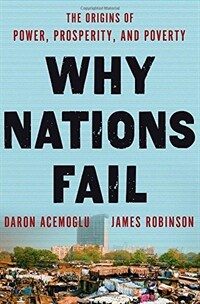
| 245 | 1 0 | ▼a Why nations fail : ▼b the origins of power, prosperity and poverty / ▼c Daron Acemoglu and James A. Robinson. |
| 250 | ▼a 1st ed. | |
| 260 | ▼a New York : ▼b Crown Publishers, ▼c c2012. | |
| 300 | ▼a 529 p., [16] p. of plates : ▼b ill., map ; ▼c 25 cm. | |
| 504 | ▼a Includes bibliographical references (p. [465]-509) and index. | |
| 650 | 0 | ▼a Economics ▼x Political aspects. |
| 650 | 0 | ▼a Economic history ▼x Political aspects. |
| 650 | 0 | ▼a Poverty ▼z Developing countries. |
| 650 | 0 | ▼a Economic development ▼z Developing countries. |
| 650 | 0 | ▼a Revolutions ▼x Economic aspects. |
| 651 | 0 | ▼a Developing countries ▼x Economic policy. |
| 651 | 0 | ▼a Developing countries ▼x Social policy. |
| 700 | 1 | ▼a Robinson, James A., ▼d 1960-. |
| 945 | ▼a KLPA |
Holdings Information
| No. | Location | Call Number | Accession No. | Availability | Due Date | Make a Reservation | Service |
|---|---|---|---|---|---|---|---|
| No. 1 | Location Main Library/Western Books/ | Call Number 330 A173w | Accession No. 111675468 (77회 대출) | Availability Available | Due Date | Make a Reservation | Service |
| No. 2 | Location Science & Engineering Library/Sci-Info(Stacks2)/ | Call Number 330 A173w | Accession No. 121258779 (8회 대출) | Availability Available | Due Date | Make a Reservation | Service |
| No. 3 | Location Sejong Academic Information Center/Social Science/ | Call Number 330 A173w | Accession No. 151333460 (10회 대출) | Availability Loan can not(reference room) | Due Date | Make a Reservation | Service |
| No. | Location | Call Number | Accession No. | Availability | Due Date | Make a Reservation | Service |
|---|---|---|---|---|---|---|---|
| No. 1 | Location Main Library/Western Books/ | Call Number 330 A173w | Accession No. 111675468 (77회 대출) | Availability Available | Due Date | Make a Reservation | Service |
| No. | Location | Call Number | Accession No. | Availability | Due Date | Make a Reservation | Service |
|---|---|---|---|---|---|---|---|
| No. 1 | Location Science & Engineering Library/Sci-Info(Stacks2)/ | Call Number 330 A173w | Accession No. 121258779 (8회 대출) | Availability Available | Due Date | Make a Reservation | Service |
| No. | Location | Call Number | Accession No. | Availability | Due Date | Make a Reservation | Service |
|---|---|---|---|---|---|---|---|
| No. 1 | Location Sejong Academic Information Center/Social Science/ | Call Number 330 A173w | Accession No. 151333460 (10회 대출) | Availability Loan can not(reference room) | Due Date | Make a Reservation | Service |
Contents information
Book Introduction
An award-winning professor of economics at MIT and a Harvard University political scientist and economist evaluate the reasons that some nations are poor while others succeed, outlining provocative perspectives that support theories about the importance of institutions.
Brilliant and engagingly written, Why Nations Fail answers the question that has stumped the experts for centuries: Why are some nations rich and others poor, divided by wealth and poverty, health and sickness, food and famine?
Is it culture, the weather, geography? Perhaps ignorance of what the right policies are?
Simply, no. None of these factors is either definitive or destiny. Otherwise, how to explain why Botswana has become one of the fastest growing countries in the world, while other African nations, such as Zimbabwe, the Congo, and Sierra Leone, are mired in poverty and violence?
Daron Acemoglu and James Robinson conclusively show that it is man-made political and economic institutions that underlie economic success (or lack of it). Korea, to take just one of their fascinating examples, is a remarkably homogeneous nation, yet the people of North Korea are among the poorest on earth while their brothers and sisters in South Korea are among the richest. The south forged a society that created incentives, rewarded innovation, and allowed everyone to participate in economic opportunities.
The economic success thus spurred was sustained because the government became accountable and responsive to citizens and the great mass of people. Sadly, the people of the north have endured decades of famine, political repression, and very different economic institutions&;with no end in sight. The differences between the Koreas is due to the politics that created these completely different institutional trajectories.
Based on fifteen years of original research Acemoglu and Robinson marshall extraordinary historical evidence from the Roman Empire, the Mayan city-states, medieval Venice, the Soviet Union, Latin America, England, Europe, the United States, and Africa to build a new theory of political economy with great relevance for the big questions of today, including:
- China has built an authoritarian growth machine. Will it continue to grow at such high speed and overwhelm the West?
- Are America&;s best days behind it? Are we moving from a virtuous circle in which efforts by elites to aggrandize power are resisted to a vicious one that enriches and empowers a small minority?
- What is the most effective way to help move billions of people from the rut of poverty to prosperity? More philanthropy from the wealthy nations of the West? Or learning the hard-won lessons of Acemoglu and Robinson&;s breakthrough ideas on the interplay between inclusive political and economic institutions?
Why Nations Fail will change the way you look at&;and understand&;the world. 
Evaluates the reasons that some nations are poor while others succeed, outlining provocative perspectives that support theories about the importance of institutions.
Information Provided By: :

Author Introduction
대런 애쓰모글루(지은이)
매사추세츠공과대학교 경제학과 특별교수이다. 1989년에 요크대학교를 졸업한 후 1990년에 런던정치경제대학교 수리경제학 및 계량경제학 분야에서 이학 석사 학위를, 1992년에 동 대학교 경제학 분야에서 박사 학위를 받았다. 그는 미국국립과학원(National Academy of Sciences), 미국학술원(American Academy of Arts and Sciences), 계량경제학회(Econometric Society), 유럽경제학회(European Economic Association), 노동경제학회(Society of Labor Economists)의 선출 회원이다. 2004년에 시카고대학교로부터 제1회 T. W. Schultz 상을, 2004년에 노동경제학에 대한 현저한 공로로 제1회 Sherwin Rosen 상을, 2006년에 터키과학학회로부터 특별과학상을, 2007년에 부다페스트 소재러이크대학으로부터 John von Neumann 상을, 2017년에 카네기 연구비를, 2018년에 장자크라퐁 상을, 2019년에 Global Economy 상을 받는 등 수많은 상을 수여하고 연구비를 지원받았다. 또한 미국경제학회(American Economic Association)가 2년마다 미국 내 40세 이하 최우수경제학자에게 수여하는 John Bates Clark 메달을 2005년에 받았으며, 2년마다 경제학 분야에서 지속적인 중요성을 가진 논문에 수여하는 Erwin Plein Neummers 상, 경제학 및 재무관리 분야의 BBVA Frontiers of Knowledge 상을 수상했다. 그리고 위트레흐트대학교와 보스포러스대학교, 아테네대학교, 빌켄트대학교, 바스대학교, 파리 사클레 소재 고등사범학교, 런던대학교 경영대학원 등에서 명예박사 학위를 받았다. 그의 관심 연구 분야는 정치경제학, 경제 발전 및 성장, 인적자본 이론, 성장 이론, 기술 혁신, 탐색 이론, 네트워크 경제학, 학습 이론 등이다. 저서로 Woodrow Wilson 상과 William Riker 상을 받은 《독재와 민주주의의 경제적 기원(Economic Origins of Dictatorship and Democracy)》(James A. Robinson과 공저), 《뉴욕타임스》의 베스트셀러로 선정된 《근대의 경제 성장에 대한 서론, 그리고 국가는 왜 실패하는가: 권력, 번영, 빈곤의 기원(Introduction to Modern Economic Growth, and Why Nations Fail: The Origins of Power, Prosperity, and Poverty)》(James A. Robinson과 공저), 《좁은 회랑: 국가, 사회, 자유의 운명(The Narrow Corridor: States, Societies, and the Fate of Liberty)》(James A. Robinson과 공저) 등이 있다. 2024년 노벨경제학상을 수상했다.
Table of Contents
Preface
Why Egyptians filled Tahrir Square to bring down Hosni Mubarak
and what it means for our understanding of the causes of
prosperity and poverty

1. So Close and Yet So Different
Nogales, Arizona, and Nogales, Sonora, have the same people,
culture, and geography. Why is one rich and one poor?

2. Theories That Don’t Work
Poor countries are poor not because of their geographies or cultures,
or because their leaders do not know which policies will enrich
their citizens

3. The Making of Prosperity and Poverty
How prosperity and poverty are determined by the incentives
created by institutions, and how politics determines what
institutions a nation has

4. Small Differences and Critical Junctures: The Weight of History
How institutions change through political conflict and how
the past shapes the present

5. “I’ve Seen the Future, and It Works”: Growth Under Extractive Institutions
What Stalin, King Shyaam, the Neolithic Revolution, and the
Maya city-states all had in common and how this explains why
China’s current economic growth cannot last

6. Drifting Apart
How institutions evolve over time, often slowly drifting apart

7. The Turning Point
How a political revolution in 1688 changed institutions in
England and led to the Industrial Revolution

8. Not on Our Turf: Barriers to Development
Why the politically powerful in many nations opposed the
Industrial Revolution

9. Reversing Development
How European colonialism impoverished large parts of the world

10. The Diffusion of Prosperity
How some parts of the world took different paths to prosperity
from that of Britain

11. The Virtuous Circle
How institutions that encourage prosperity create positive feedback

12. The Vicious Circle
How institutions that create poverty generate negative
feedback loops and endure

13. Why Nations Fail Today
Institutions, institutions, institutions

14. Breaking the Mold
How a few countries changed their economic trajectory by
changing their institutions

15. Understanding Prosperity and Poverty
How the world could have been different and how understanding
this can explain why most attempts to combat poverty have failed

Acknowledgments
Bibliographical Essay and Sources
References
Index