

| 000 | 00000cam u2200205 a 4500 | |
| 001 | 000046088396 | |
| 005 | 20210805150426 | |
| 007 | ta | |
| 008 | 210805s2020 si a b 001 0 eng d | |
| 020 | ▼a 9789811537028 | |
| 035 | ▼a (KERIS)BIB000015683047 | |
| 040 | ▼a 211046 ▼c 211046 ▼d 211009 | |
| 082 | 0 4 | ▼a 320.9519 ▼2 23 |
| 084 | ▼a 320.953 ▼2 DDCK | |
| 090 | ▼a 320.953 ▼b I31d | |
| 100 | 1 | ▼a Im, Hyŏk-paek. |
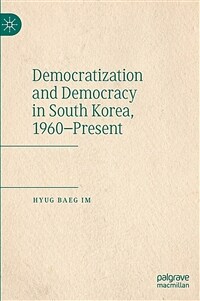
| 245 | 1 0 | ▼a Democratization and democracy in South Korea, 1960-present / ▼c Hyug Baeg Im. |
| 260 | ▼a Singapore : ▼b Palgrave Macmillan, ▼c c2020. | |
| 300 | ▼a xxiii, 319 p. : ▼b ill. ; ▼c 22 cm. | |
| 504 | ▼a Includes bibliographical references (p. 299-308) and index. | |
| 650 | 0 | ▼a Politics and culture ▼z Korea (South). |
| 651 | 0 | ▼a Korea (South) ▼x Politics and government. |
| 900 | 1 0 | ▼a Im, Hyug Baeg. |
| 945 | ▼a KLPA |
Holdings Information
| No. | Location | Call Number | Accession No. | Availability | Due Date | Make a Reservation | Service |
|---|---|---|---|---|---|---|---|
| No. 1 | Location Main Library/Western Books/ | Call Number 320.953 I31d | Accession No. 511047924 (6회 대출) | Availability Available | Due Date | Make a Reservation | Service |
Contents information
Book Introduction
This book analyses democratization and democracy in South Korea since 1960. The book starts with an analysis of the distinctive characteristics of bureaucratic authoritarianism and how democratic transition had been possible after inconclusive and protracted “tug of war” between authoritarian regime and democratic opposition. It then goes on to explore what the opportunities and constraints to the new democracy are to be a consolidated democracy, how new democracy had changed the industrial relations in the post-transition period, how premodern political culture such as Confucian patrimonialism and familism had obstructed democratic consolidation, and the improvement of quality of democracy. The author compares empirically, from the perspective of a comparative political scientist, political regime superiority of democracy over authoritarianism with regard to economic development. He concludes that “democratic incompetence” theory has been proven wrong and, in South Korea, democracy has performed better than authoritarian regimes in terms of economic growth with equity, employment, distribution of income, trade balance, and inflation.
This book will benefit political scientists, development economists, labor economists, religious sociologists, military sociologists, and historians focusing on East Asian history.
New feature
This is a perfect one-country study: deeply engaged in the theoretical and comparative literature, intimately informed about South Korean history, bringing to bear some unknown aspects of the case. A major contribution to studies of authoritarianism and of transitions to democracy.
?Adam Przeworski, Carroll and Milton Petrie Professor Emeritus, Department of Politics, New York University, USA
This book will benefit political scientists, development economists, labor economists, religious sociologists, military sociologists, and historians focusing on East Asian history.
Hyug Baeg Im is a professor emeritus at Korea University and a chaired professor at GIST. He received his M.A. and Ph.D. from the University of Chicago, USA. He served as an EC member of IPSA and received ROK National Academy of Sciences Prize. Prof. Im's recent publications includeThe Possibility of Peace in the Korean Peninsula (2017) and Mongering North Korean Democracy for Inter-Korean Peace (2015).
Information Provided By: :

Author Introduction
임혁백(지은이)
현재 고려대 정치외교학과 명예교수이다. 서울대에서 정치학 학사, 시카고대에서 정치학 석사, 박사를 받았다. 그는 광주과학?술원 (GIST)에서 석좌교수, 세계정치학회 (IPSA) 집행위원, 고려대 정책대학원 원장 등을 역임했다. 이화여대, 조지타운대, 듀크대, 스탠퍼드대에서 강의를 했고 존스 홉킨스대 SAIS와 National Endowment for Democracy 에서 연구를 했다. 그는 김대중대통령과 노무현대통령의 정책자문위원이었고, 통일 부, 국방부, 국회 입법조사처에서 자문을 하였다. 임혁백 교수는 대한민국학술원 학술원상 (2015), 한국정치학회 학술상 (2010), ICAS (아시아학자세 계총회) 우수학술도서상 (2017)을 수상하였고, 홍조근정훈장(2003)을 받았다. 최근에 출판된 임교수의 저서는 『Democratization and Democracy in South Korea, 1960-Present』(Palgrave Macmillan, 2020), 민주주의의 발전과 위?』(김영사,2021), 『비동시성의 동시성: 한국 근대정치의 다중적 시간』(고려대 출판부, 2014), 『The Possibility of Peace in the Korean Peninsula』 (SNU Press, 2017) 등이 있다.
Table of Contents
1. Introduction: My democratization studies in retrospect.2. The rise of bureaucratic authoritarianism in South Korea.3. Recasting Park Chung Hee''s authoritarianism: myths, reality, and legacies.4. Politics of democratic transition from authoritarian rule in South Korea.5. Christian churches and democratization in South Korea.6. Opportunities and constraints to democratic consolidation in South Korea.7. From affiliation to association: the challenge of democratic consolidation in Korean industrial relations.8. Faltering democratic consolidation in South Korea: democracy at the end of Three Kims era.9. The development and change of Korean democracy since democratic transition in 1987: Three Kims Politics and after.10. Democratic development and authoritarian development compared.11. Better democracy, better economic growth?