

| 000 | 01067camuu2200289 a 4500 | |
| 001 | 000045145701 | |
| 005 | 20131022150842 | |
| 008 | 870519s1984 maua b 001 0 eng d | |
| 010 | ▼a 84012862 | |
| 020 | ▼a 0674325257 | |
| 035 | ▼a KRIC00408660 | |
| 040 | ▼a 211032 ▼c 211032 ▼d 211009 | |
| 043 | ▼a a-cc--- | |
| 050 | 0 | ▼a DS754.14 ▼b .E44 1984 |
| 082 | 0 4 | ▼a 001.20951 ▼2 23 |
| 084 | ▼a 001.20951 ▼2 DDCK | |
| 090 | ▼a 001.20951 ▼b E48f | |
| 100 | 1 | ▼a Elman, Benjamin A., ▼d 1946-. |
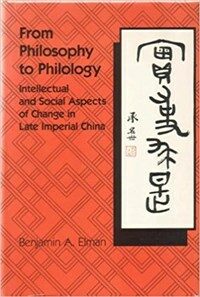
| 245 | 1 0 | ▼a From philosophy to philology : ▼b intellectual and social aspects of change in late imperial China / ▼c by Benjamin A. Elman. |
| 260 | ▼a Cambridge : ▼b Harvard Univ. Press, ▼c 1984. | |
| 300 | ▼a xxv, 368 p. : ▼b ill. ; ▼c 24 cm. | |
| 490 | 1 | ▼a Harvard East Asian monographs ; ▼v 110 |
| 504 | ▼a Includes bibliographical references (p. [309]-339) and index. | |
| 650 | 0 | ▼a Learning and scholarship ▼z China ▼x History. |
| 651 | 0 | ▼a China ▼x Intellectual life ▼y 1644-1912. |
| 830 | 0 | ▼a Harvard East Asian monographs ; ▼v 110. |
소장정보
| No. | 소장처 | 청구기호 | 등록번호 | 도서상태 | 반납예정일 | 예약 | 서비스 |
|---|---|---|---|---|---|---|---|
| No. 1 | 소장처 중앙도서관/서고6층/ | 청구기호 001.20951 E48f | 등록번호 511008736 | 도서상태 대출가능 | 반납예정일 | 예약 | 서비스 |
| No. 2 | 소장처 중앙도서관/민족문화연구원/ | 청구기호 001.20951 E48f | 등록번호 192032332 | 도서상태 대출불가(자료실) | 반납예정일 | 예약 | 서비스 |
| No. 3 | 소장처 중앙도서관/민족문화연구원/ | 청구기호 천원 001.20951 E48f | 등록번호 192055801 | 도서상태 대출불가(열람가능) | 반납예정일 | 예약 | 서비스 |
컨텐츠정보
책소개
From Philosophy to Philology is an indispensable work on the intellectual life of China’s literati in the seventeenth and eighteenth centuries. While there was not a scientific revolution in China, there was an intellectual one. The shock of the Manchu conquest and the collapse of the Ming dynasty in 1644 led to a rejection of the moral self-cultivation that dominated intellectual life under the Ming. China’s scholars, particularly in the Yangzi River Basin, sought to restore China’s greatness by recapturing the wisdom of the ancients from the Warring States period (403?221 B.C.) and the Former Han dynasty (202 B.C.?9 A.D.), much as Renaissance Europe rediscovered the Greeks and Romans. But in China scholars faced the daunting task of determining which of many editions of the Classics were the true originals and which were forged additions of later centuries.
The ensuing search for authentic texts led to the founding of academies and libraries, the compiling of bibliographies, the rise of printing of editions of the Classics and Histories and commentaries on their components, the study of ancient inscriptions, and a two-hundred-year effort to discover and discard forged texts. In the process rigorous standards of scholarly training were adopted, and scholarship became a full-time profession distinct from gentry farmers or imperial officials.
정보제공 :

목차
CONTENTS
ACKNOWLEDGMENTS = ⅶ
FOREWORD = xiii
PREFACE = xix
EXPLANATORY NOTES = xxiii
1. A REVOLUTION IN DISCOURSE IN LATE IMPERIAL CHINA = 1
 The Context of Lower Yangtze Academic = 7
 Politics and Scholarship in the Manchu State = 13
 The Unraveling of Neo-Confucianism = 26
2. K'AO-CHENG SCHOLARSHIP AND THE FORMATION OF A SHARED
 EPISTEMOLOGICAL PERSPECTIVE = 37
 The Emergence of K'ao-cheng ScholarshiI = 39
 The Impact of the Fall of the Ming Dynasty = 49
 The Impact of Precise Scholarship = 57
 Specialization and Precise Scholarship = 67
3. THE PROFESSIONALIZATION OF LOWER YANGTZE ACADEMICS = 87
 Social Origins of K'ao-cheng Scholars = 89
 Professionalization in Late Imperial China = 96
 Official and Semiofficial Patronage = 100
 Academics in the Kiangnan Academic Community = 112
 The Transformation of Literati Roles = 130
4. SCHOLARSHIP, LIBRARIES, AND BOOK PRODUCTION = 139
 Libraries in Kiangnan = 143
 Printing in Kiangnan = 151
 Reference Materials and Evidential Research = 160
 Classification of Knowledge = 163
5. CHANNELS OF SCHOLARLY COMMUNICATION IN KIANGNAN = 171
 Shared Research Techniques: Notation Books = 174
 The Use of Data in Kao-c eng Discourse = 177
 Collaboration, Correspondence, and Meetings = 198
 Cumulative Research = 204
 Priority Debates = 221
 Progress in Evidential Scholarship = 228
6. DENOUEMENT = 231
 The Fracturing of the K'ao-cheng Movement = 233
 The Impact of the Taiping Rebellion = 248
 Epilogue = 254
 ABBREVIATIONS USED IN THE NOTES = 259
NOTES = 261
BIBLIOGRAPHY = 309
GLOSSARY = 341
INDEX = 353