

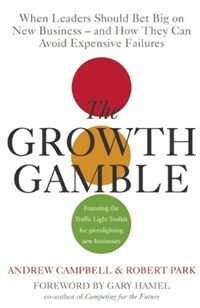
The growth gamble : when leaders should bet big on new businesses and how to avoid expensive failures
| 000 | 01379camuu22002898a 4500 | |
| 001 | 000045200563 | |
| 005 | 20051026111717 | |
| 008 | 050218s2005 mau b 001 0 eng | |
| 020 | ▼a 1904838049 | |
| 040 | ▼a DLC ▼c DLC ▼d DLC ▼d 244002 | |
| 082 | 0 0 | ▼a 658.1/1 ▼2 22 |
| 090 | ▼a 658.11 ▼b C187g | |
| 100 | 1 | ▼a Campbell, Andrew. |
| 245 | 1 4 | ▼a The growth gamble : ▼b when leaders should bet big on new businesses and how to avoid expensive failures / ▼c Andrew Campbell & Robert Park. |
| 260 | ▼a Boston : ▼b Nicholas Brealey International, ▼c 2005. | |
| 263 | ▼a 0504 | |
| 300 | ▼a xv, 321 p ; ▼c 24 cm. | |
| 504 | ▼a Includes bibliographical references and index. | |
| 505 | 0 | ▼a The challenge of new businesses -- Beating the odds -- The difficulties of building new legs -- When low growth is better than gambling -- The new business traffic lights -- Diversification -- Searching for new businesses -- Is there a role for corporate venturing? -- Positioning and supporting a new business -- An age of realism. |
| 650 | 0 | ▼a Conglomerate corporations ▼x Planning. |
| 650 | 0 | ▼a Conglomerate corporations ▼x Management. |
| 650 | 0 | ▼a Corporations ▼x Growth. |
| 650 | 0 | ▼a Business planning. |
| 650 | 0 | ▼a Corporate culture. |
| 700 | 1 | ▼a Park, Robert. |
Holdings Information
| No. | Location | Call Number | Accession No. | Availability | Due Date | Make a Reservation | Service |
|---|---|---|---|---|---|---|---|
| No. 1 | Location Sejong Academic Information Center/Social Science/ | Call Number 658.11 C187g | Accession No. 151185151 | Availability Available | Due Date | Make a Reservation | Service |
Contents information
Book Introduction
The received wisdom is to try harder, to be more innovative, to take more risk - and almost every company tries. There are only a tiny percentage of management teams who settle for sticking to their core businesses and declining gracefully as the business matures. But the received wisdom is wrong. At least 90% of attempts fail. Even companies that succeed often do so at the expense of long term shareholder value. This book gives managers an alternative. Instead of investing heavily in searching for and experimenting with new growth areas, in developing an innovative culture or in building processes for nurturing new ventures, Campbell advises managers how to be far more selective and to invest in a new business only when the opportunity has a high enough probability of success. A nuts-and-bolts antidote to the received wisdom of ¡°innovation¡± and a decade of wasted acquisitions and ¡°corporate venturing. ¡± The Growth Gamble explains why most companies¡? strategies for innovation and growth failed despite the fact that their core business had good prospects.
Information Provided By: :

Author Introduction
로버트 파크(지은이)
영국의 금융산업 분야에서 25년간 활동했으며, 넷웨스트 그룹의 기업전략 수석 컨설턴트로 12년간 근무했다. 2007년 현재 애쉬리지 전략경영 센터의 협력사로 독립적으로 컨설팅을 수행하고 있다.
Andrew Campbell(지은이)